Add the one thing your LLM is missing: the ability to reason about your business.
ExecutiveIf your experts can explain how something works, we can turn that into a model your LLM can reason with, not just talk about. That’s EARA: the architecture, not a data science project.
Executive Summary
Your LLM talks fluently but doesn’t reason about your business. That knowledge lives in your experts, not your data. We build the causal model that gets it out and connects it to the AI you already run. It’s a real moat: everyone rents the same LLM, nobody else has your model. Twelve industries already have a starting point, so it doesn’t begin from scratch. The commitment starts small: one decision, one model. And the underlying method is real, published research, not a black box.
Twenty-five years across insurance, banking, energy, healthcare, cybersecurity, supply chain, and public sector. Every engagement, the same pattern: the knowledge that would have made the model work was sitting in the room, not in the data. The world is now spending billions to automate that same mistake (poor Watson).
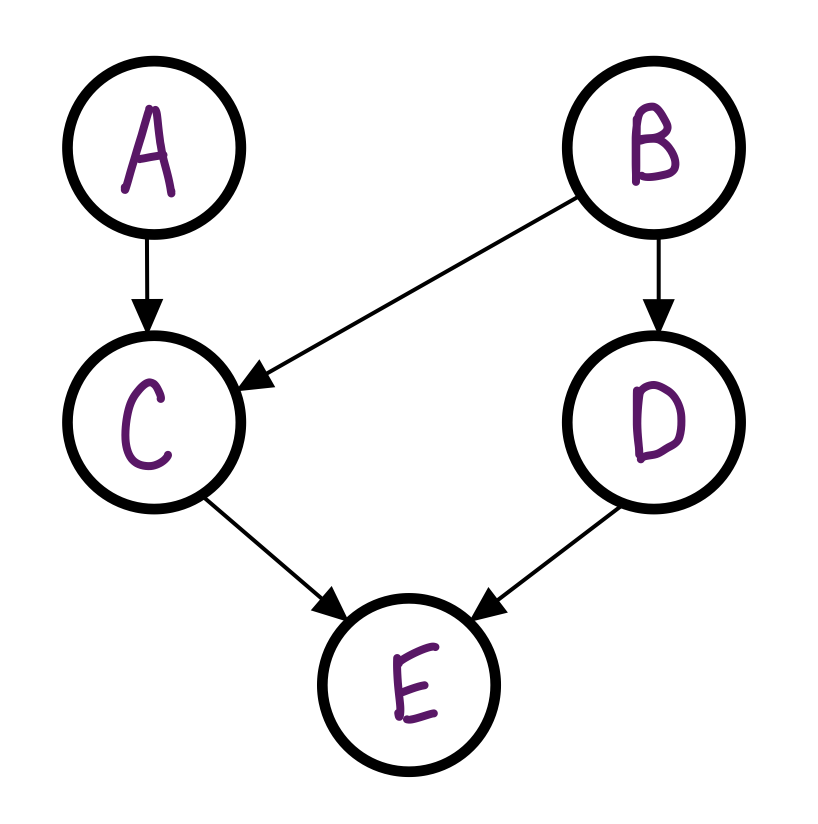
A causal model
01 Add Cognition →
Drop in how your experts reason, and your AI can reason too.
The missing piece is a causal model, a cause-and-effect map of your domain, built from your experts’ knowledge, that gives your LLM something to reason with.
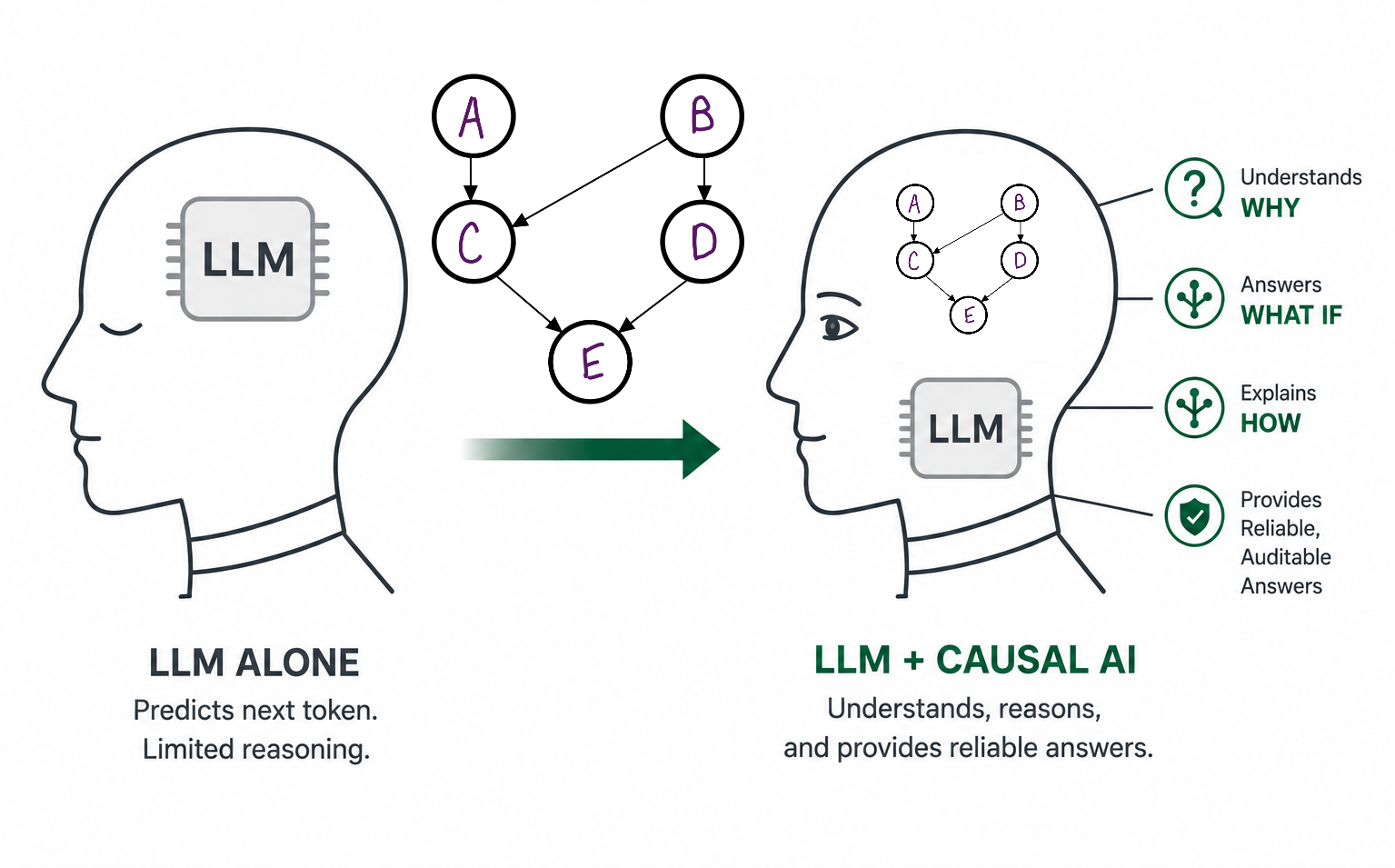
Built from your experts’ knowledge, not scraped from the web. Your people ask; the model reasons; your LLM translates.


Together, these four properties close a loop that most AI deployments leave open: expert knowledge goes in, auditable answers come out, corrections go back in. The organisation gets smarter with every decision.
How seven reasoning services turn one causal model into answers for seven different classes of question.
Probability answers one question. Four more require actual causal reasoning to answer at all.
Example. Your strategy team asks: if we enter this market, what is the expected return, and what is the chance we lose money? Your LLM says it depends. This one lays out three options with expected NPV and loss probability for each, with the assumptions named, the reasoning shown, and a certificate your board can contest. See the model →
02 The Limits
Seven structural failures. None fixable by prompt engineering.
Large language models are powerful but structurally limited. The limits are not bugs. They are inherent in their architecture. These matter for high-stakes decisions.
- Trained on everyone else’s data: not yours.
- Frequency-based: they hallucinate where data is thin.
- Pattern-matching only: association masquerading as causation.
- Black boxes: no reasoning trail, no audit path.
- Static: blind to regime change.
- Optimised for the average: your needs are not average.
- No mechanism: predict outcomes but cannot tell you why.
Six specific reasons fluent output isn’t the same thing as reasoning about your business.
A model whose parameters can’t be read is a model whose assumptions can’t be contested.
It estimates an association. It can’t tell you what would happen if you intervened, or what would have been different.
03 Your Moat
Everyone rents the same LLM. Only you can own a model of your domain.
You and your competitors are renting the same LLMs. But a model of your domain isn’t something you can rent. It encodes what your experts know, and no competitor can extract it from a training set.
Your domain models compound in ability. Each engagement deepens the library. The next model costs less than the first and answers more than the last.
Every answer is auditable: named assumptions, traceable reasoning, a certificate your regulators can inspect. When a regulator challenges the decision, the reasoning is there. When an expert finds an error, they can trace it to its assumption and correct it. The same property that satisfies your regulator makes your organisation smarter.
This year's AI layoffs are a bet that a vendor's model can replace a domain expert, indefinitely, at whatever price and quality that vendor sets going forward. A domain model is the opposite bet. It doesn't replace the expert. It keeps what they know, owned, auditable, and running regardless of what any single LLM vendor does next. Read the argument →
Every competitor has the same LLM. None of them has your domain model.
04 The Pitch
Pre-built models, calibrated to your organisation. You own the result.
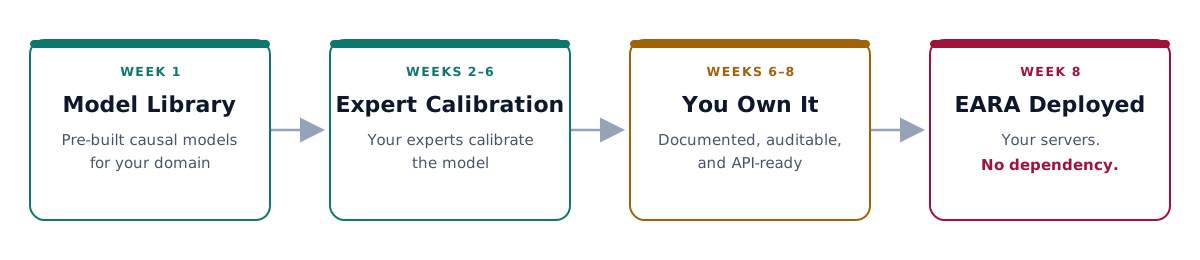
Rung3 maintains a library of pre-built causal models across domains. Your subject-matter experts and I calibrate them to your organization: your data, your decisions, your edge cases. Four to eight weeks later, you own the result: a documented, auditable reasoning infrastructure queryable by any LLM you already run via a Python, R, or C API. Running on your servers. Under your governance. No vendor in the loop. No report. No deck. No dependency.
What you get is a .bayes model and the code layer that operates on it, seven reasoning primitives executable via Python, R, or C API. The LLM asks the questions. The code computes the answers.
05 Example Plug-ins
Twelve domains. Each model ready to calibrate and deploy.
Some from our library of domain plug-ins. Each one can be calibrated to your organisation, owned outright, and deployed on your infrastructure, not ours.
07 The Foundations
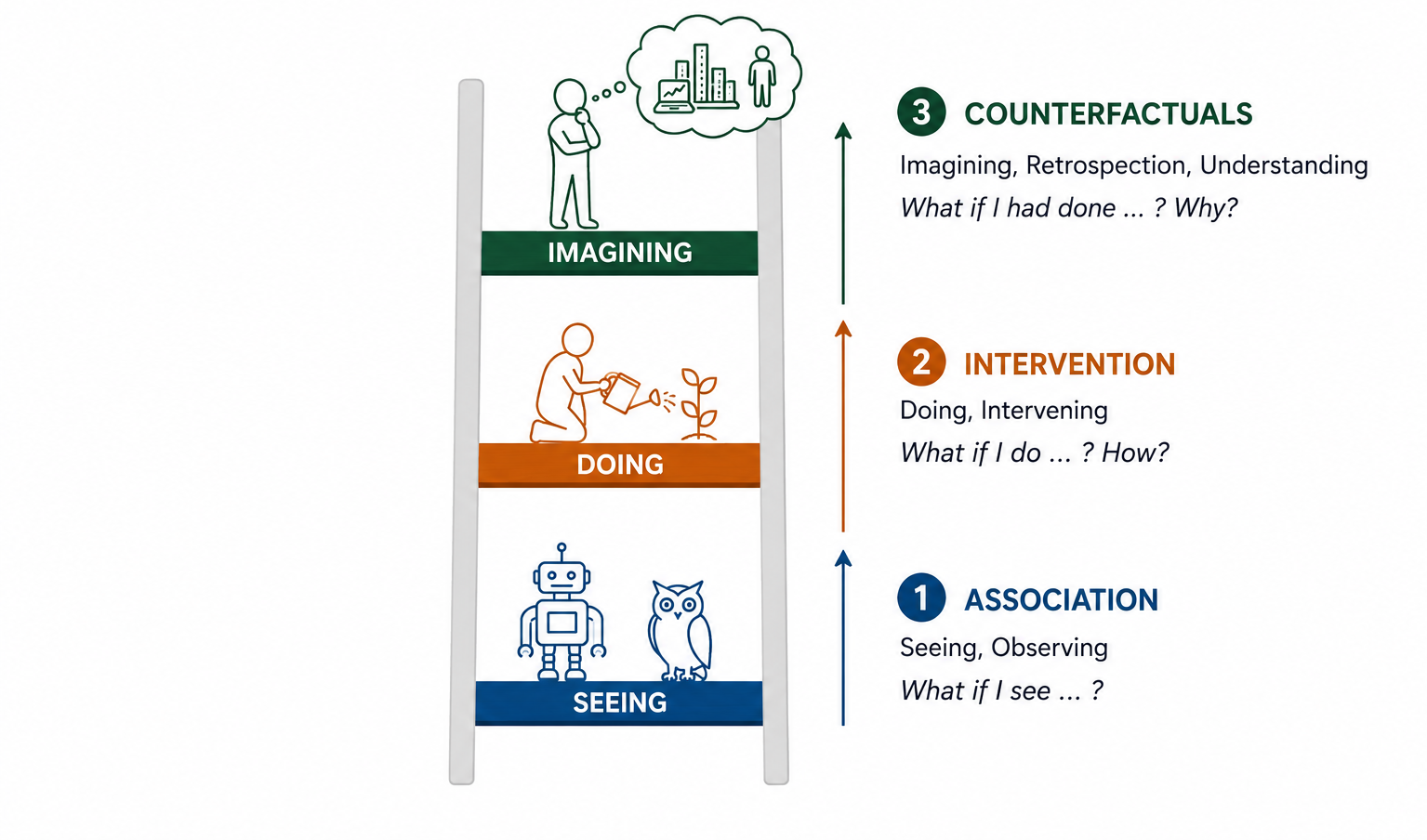
Pearl’s Ladder, Bayesian networks, structural causal models: established science.
The architecture rests on established theory: Pearl’s Ladder of Causation, Bayesian networks, and structural causal models. These are peer-reviewed, decades-tested techniques, named in Gartner’s Hype Cycle for AI.
06 One Decision
Don’t schedule a demo. Send me the decision your team is stuck on.
Don’t schedule a demo. Send me the decision your team is stuck on. I’ll tell you in half a day whether a causal model can answer it, and what the answer is.
Marc Vandenplas · info@rung3.ai
San Francisco · rung3.ai