The Five Questions
ExecutiveProbability is the first question. The other four require causality.
01 Pearl's Ladder
Seeing, doing, imagining. Most AI only sees.
The ladder is a hierarchy of reasoning. Each rung requires strictly more than the one below it. You cannot answer a Rung 2 question with Rung 1 tools, and you cannot answer a Rung 3 question with Rung 2 tools. Most enterprise AI operates exclusively at Rung 1.
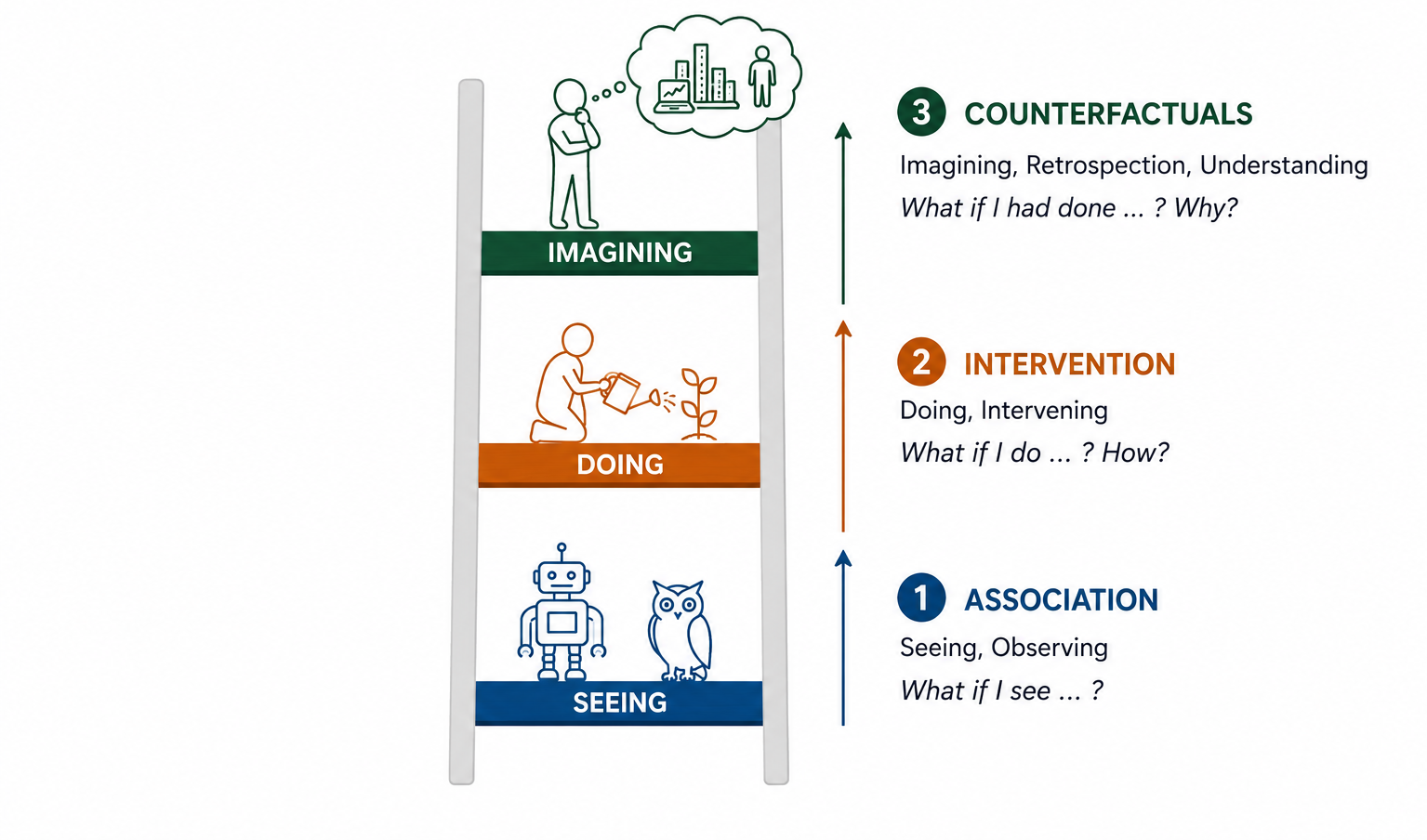
Judea Pearl & Dana Mackenzie, The Book of Why: The New Science of Cause and Effect, Basic Books, 2018.
Every organisation that manages risk eventually needs to answer the same five questions. Most AI systems answer only the first.
Rung 1 · Assessment: What is the probability of failure right now?
Rung 1 · Diagnosis: Why is that risk increasing? Which factors are driving it?
Rung 2 · Intervention: Which action reduces the risk the most, within our constraints?
Rung 1 · Inquiry: What information would most reduce our uncertainty before we decide?
Rung 3 · Counterfactual: What would have happened if we had acted differently?
A predictive model answers the first question. Decision intelligence answers all five.
02 What Current Approaches Miss
Score cards give a number. Predictive models give a probability. Neither gives a reason.
The enterprise risk landscape has three incumbent approaches. Each solves part of the problem and leaves the rest unanswered.
| Approach | What it provides | What it cannot do |
|---|---|---|
| Score cards & rules | Transparent, auditable, deterministic | Cannot handle uncertainty. Cannot explain a borderline case. Goes stale when the world changes. |
| Predictive ML | Learns from data. High accuracy at scale. | Finds correlations, not causes. Cannot evaluate interventions. Cannot answer “why.” Breaks when the distribution shifts. |
| Expert judgment | Domain knowledge. Handles edge cases. | Not reproducible. Not scalable. Not auditable. Inconsistent under pressure. |
| Causal reasoning | Probabilistic, causal, explainable, auditable. | Requires expert input to build the domain model. Complements data, does not replace it. |
A risk score of 0.83 that cannot be explained to a board, a regulator, or an affected party is operationally incomplete, regardless of how accurate it is.
03 The Reasoning Loop
A reasoning loop that updates as evidence arrives.
Prediction is a one-way pipeline: data in, score out. Decision intelligence is a loop.
Evidence arrives. Beliefs update. Reasoning runs on the new state. The next most useful question is identified. More evidence arrives. Over time, what the model experiences improves the model itself.
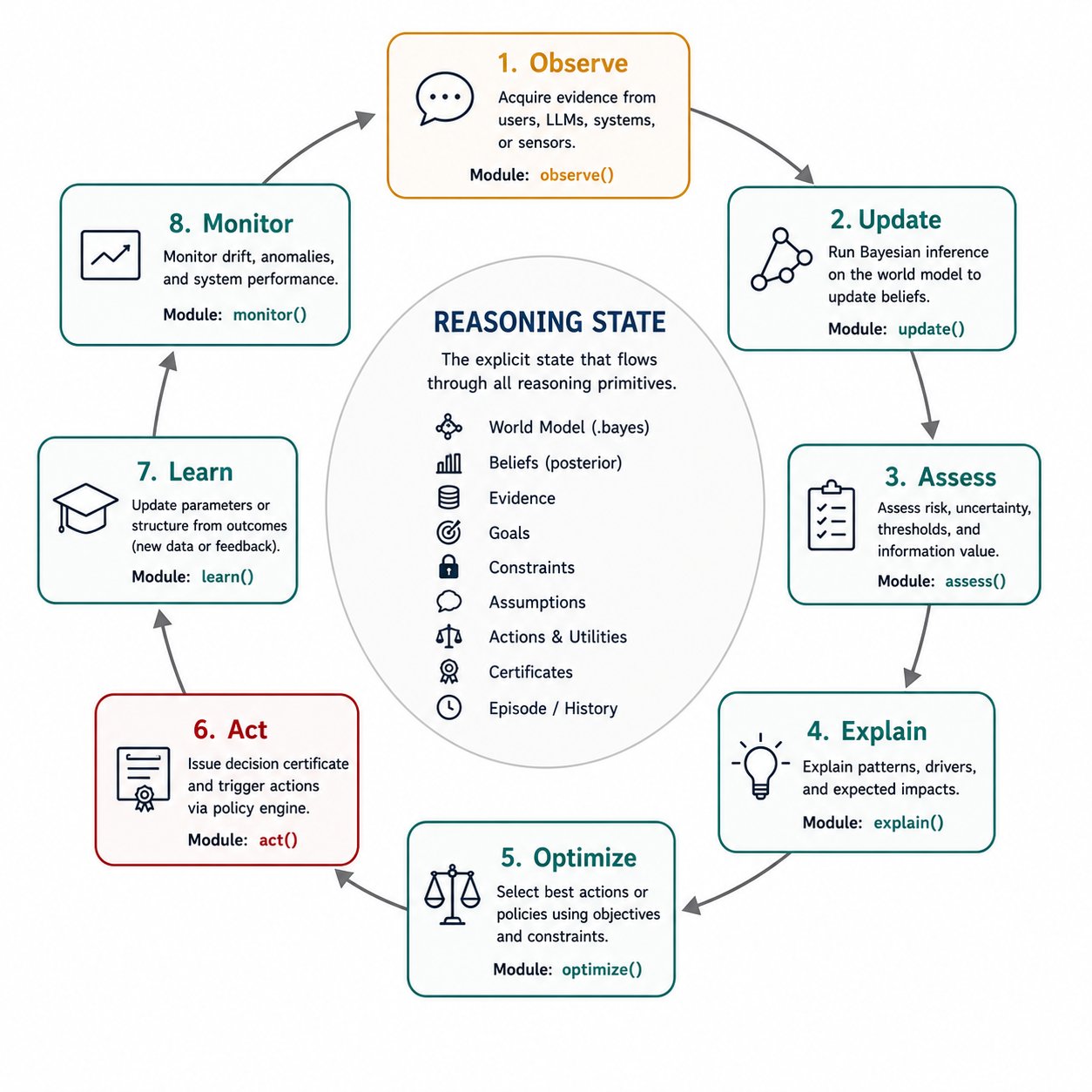
The reasoning loop. Amber nodes are the LLM interface, natural language in, narrated output back. Red is the decision artifact. Green is the deterministic reasoning core. The domain model at the centre is the belief state that all eight operations share.
The LLM handles language at both ends, it reads the question and narrates the answer. Everything in between is deterministic computation on an explicit domain model.
04 Risk Assessment
A probability with a named cause.
Risk assessment here is not a lookup. It is a live calculation.
Evidence arrives from sensors, documents, analyst notes, and system logs. Each piece updates the model’s current belief about the risk variable. A clinician’s “this looks like sepsis” or an analyst’s “this login seems off” counts as soft evidence, a calibrated probability rather than a hard yes or no, and shifts the estimate in proportion to how confident the observation was.
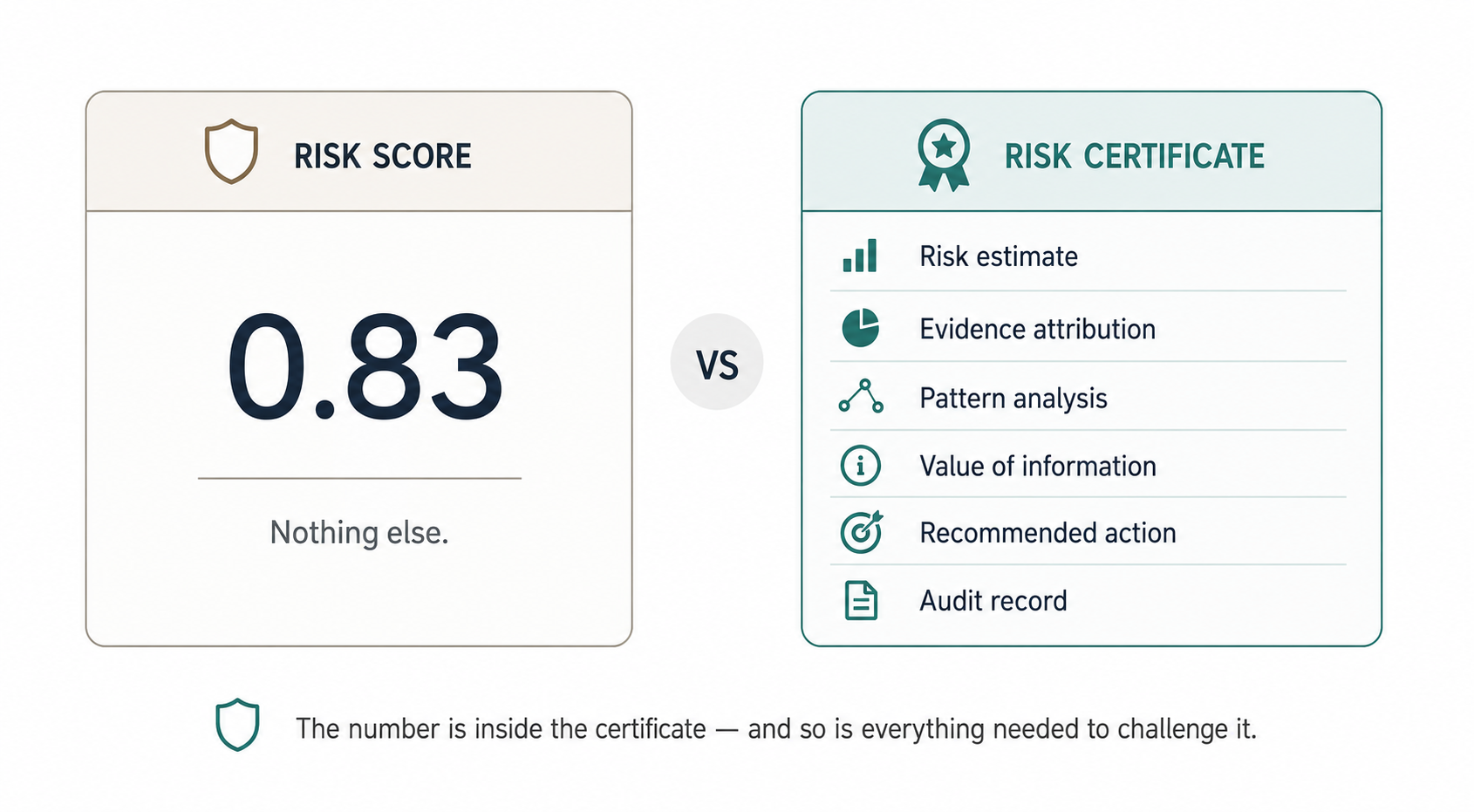
What comes back is not just a number. It is a certificate that carries: the current risk estimate, which evidence moved it and by how much, how this case compares to past cases, what information would most change the decision, and a recommended action. The number is inside the certificate, and so is everything needed to challenge it.
05 Risk Monitoring
A model that watches itself, not just the variables it was built to watch.
Static risk systems are calibrated once. The world changes. A new attack pattern, a process shift, a regulatory change, any of these can make a model that was right last quarter systematically wrong this quarter, without any individual score looking alarming.
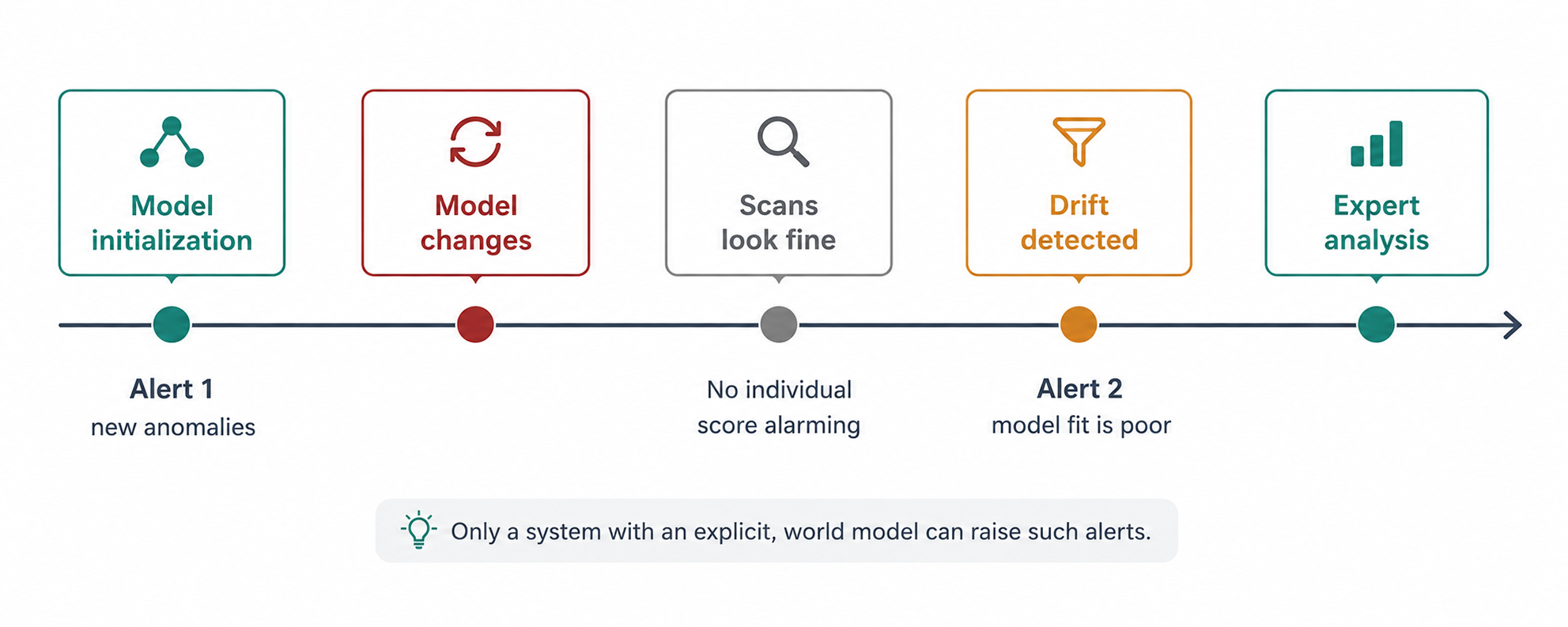
This architecture raises two distinct alerts: this case is unusual given the current model, and the model’s predictions are drifting from reality, something in the world may have changed. Only a system with an explicit domain model can tell the difference.
See Architecture · Monitoring → for the full treatment.
06 Decision Optimization
From “what is the risk?” to “what should we do about it?”
Risk assessment answers the first question. Decision optimization answers the second. Given the current risk estimate and a set of possible actions, with their costs and constraints, the system identifies the combination that best meets the objective.
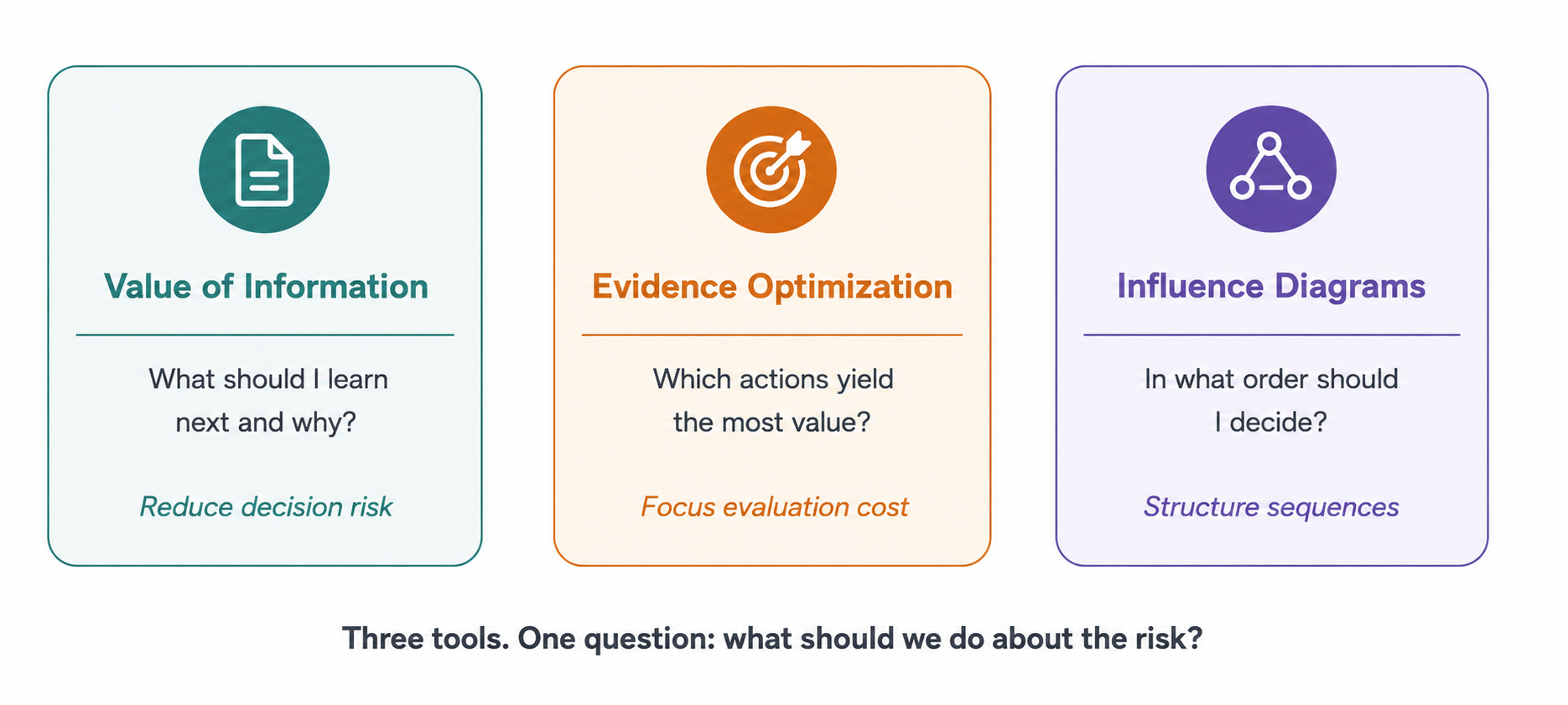
Value of Information identifies the single piece of missing evidence that would most change the decision. Evidence optimization finds the best set of actions within constraints. Influence Diagrams handle situations where the order of decisions matters.
See Architecture · Optimization → for the full treatment.
07 Explainability
The explanation is not generated after the fact. It is read directly off the model.
Most AI risk systems produce a score and then try to explain it separately, with a second model or a post-hoc attribution tool. That explanation was not part of the original computation. It is an approximation.
In this architecture, the explanation is structural. The certificate carries:
- The full probability distribution over possible outcomes.
- Which evidence moved the estimate and by how much.
- How this case compares to similar past cases.
- What information was missing and how much it would have mattered.
- The explicit assumptions the model invoked, and where to challenge them.
- A complete audit record: model version, evidence, timestamp. Reproducible by design.
The audit question. An auditor asks: “Why was this credit application declined?” The answer: the probability of default was 0.76, driven mainly by debt-to-income ratio (+0.31) and two prior late payments (+0.22), against a threshold of 0.25. The model version, the identification method, and the contestable assumptions are all in the record. That is an explanation, not a summary.
08 Where it fits
A layer, not a replacement. Sits behind the LLM you already run.
Decision intelligence sits inside your existing systems, not in place of them.
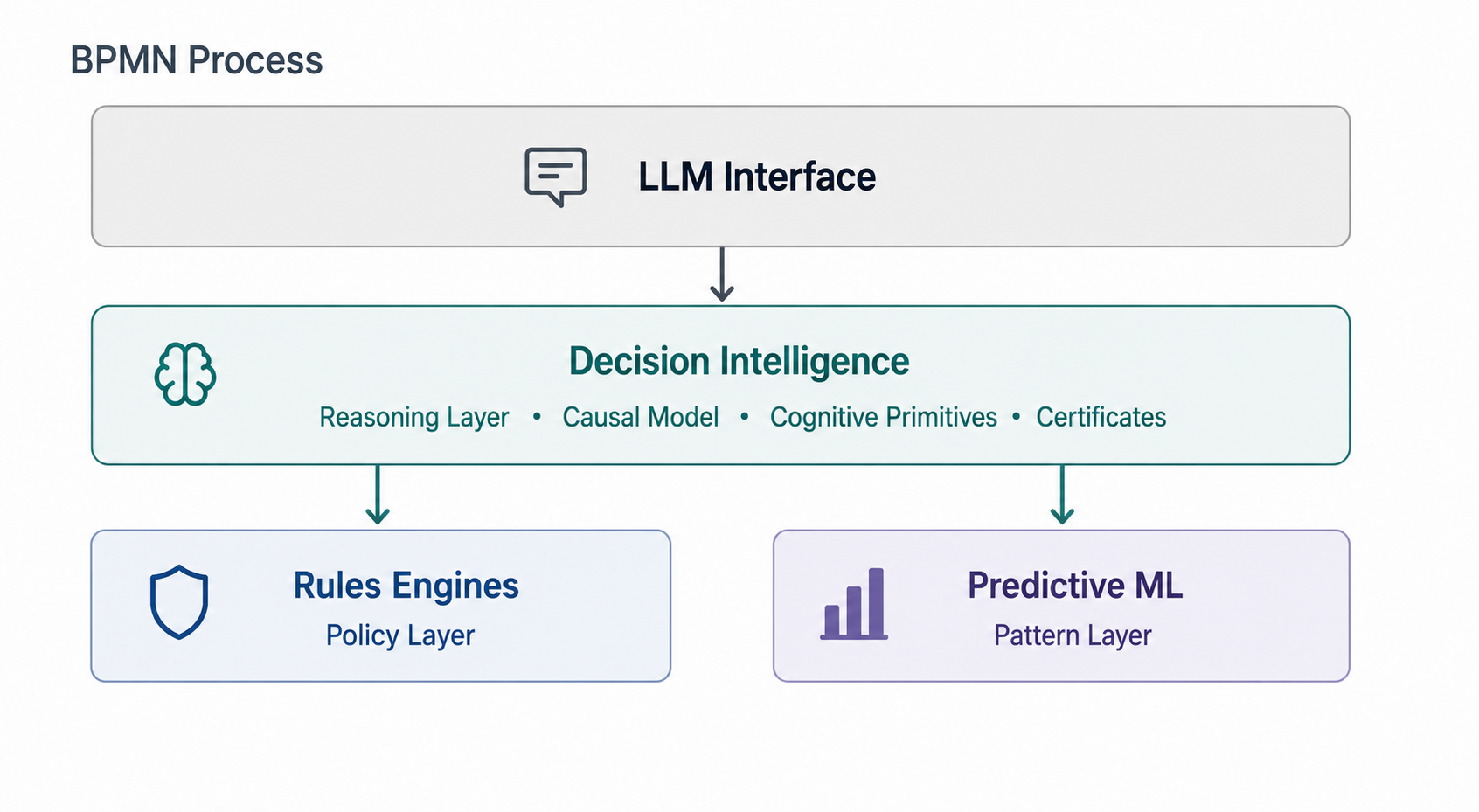
- Inside BPMN processes. Every gateway that needs expert judgment becomes a call to the decision service. See BPMN integration →
- Alongside predictive ML. ML finds patterns at scale. Causal reasoning evaluates what to do about them. The two are complementary.
- Above rules engines. Your existing rules engine stays as the policy layer. What changes is the quality of the input it receives.
- As the reasoning core of an LLM application. An LLM connected to this architecture reads a computed result, it does not guess. See Cognition →
The architecture underlying this is formally specified as EARA, the Enterprise AI Reasoning Architecture. EARA is the blueprint. Decision Intelligence is what it delivers.