The Seven Cognitive Primitives
Executive TechnicalSeven cognitive primitives, reusable reasoning services that operate on a shared domain model and produce certified artifacts. The model is the substrate. The analyses are the intelligence.
01 What is cognition in EARA?
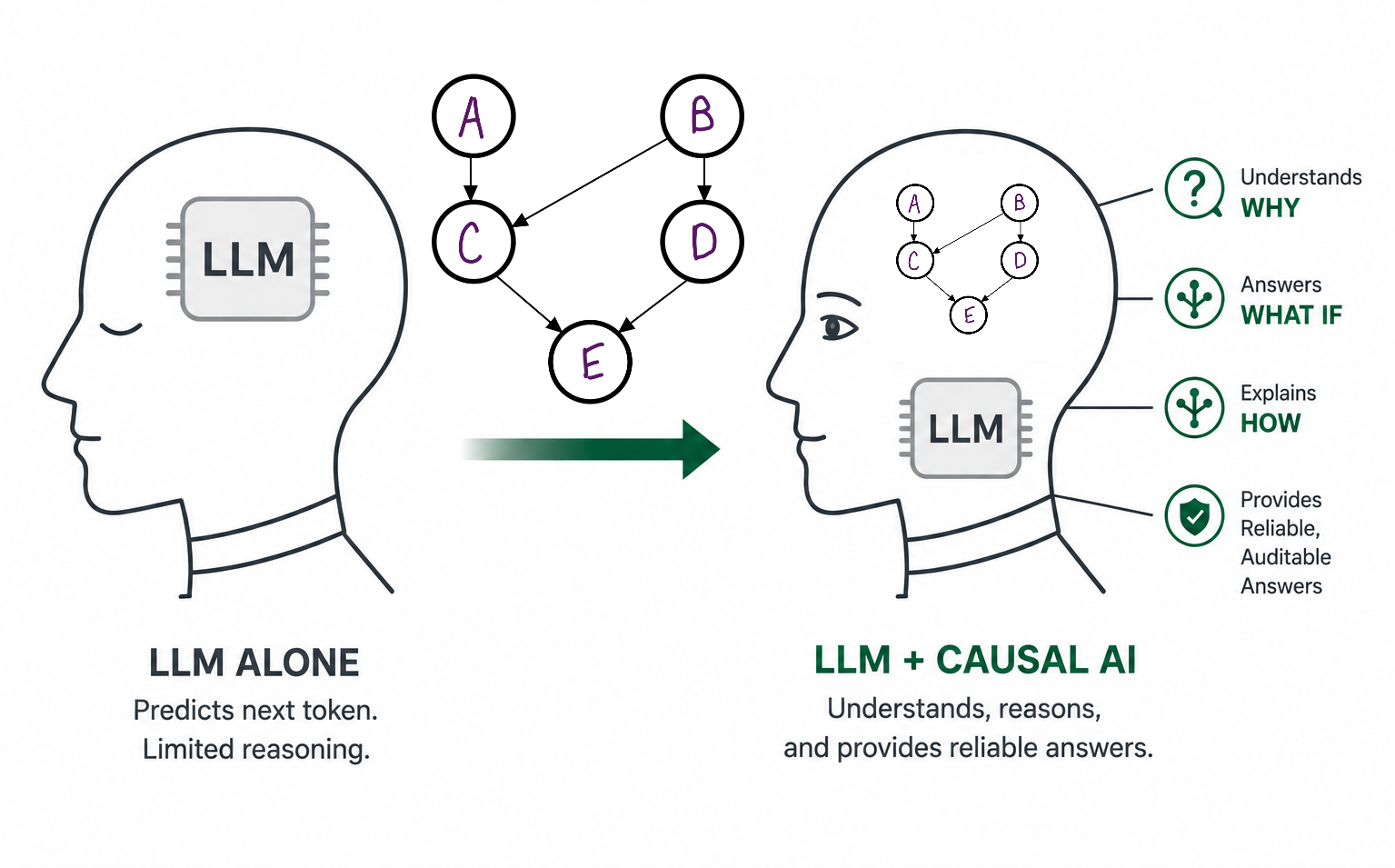
Cognition in EARA is the compound capability that emerges when an LLM's linguistic intelligence is paired with a Bayesian causal model's structural knowledge. Neither component is sufficient alone. The LLM handles language, parsing intent, retrieving associations, generating fluent output, but it operates at Rung 1 of Pearl's ladder: pattern matching over observed co-occurrences. It cannot reason about interventions or counterfactuals because it has no model of mechanism. The Bayesian network holds the causal structure, variables, dependencies, CPTs, do-calculus, but it cannot converse, interpret ambiguous inputs, or explain results in plain language.
EARA's claim is that the combination clears the bar for genuine decision-support cognition: the system can receive a question in natural language, route it to the appropriate causal query, execute that query against the structural model, and return an answer grounded in mechanism rather than correlation.
Cognition = language understanding × causal reasoning. Either factor zeroed out collapses the product, though “×” is a simplification; see why “×” is the wrong operator.
The practical meaning: an AI system that reasons like your best expert, not like a pattern-matcher over historical data. The causal model encodes the expert’s judgment. The LLM makes it conversational. The combination gives AI domain judgment.
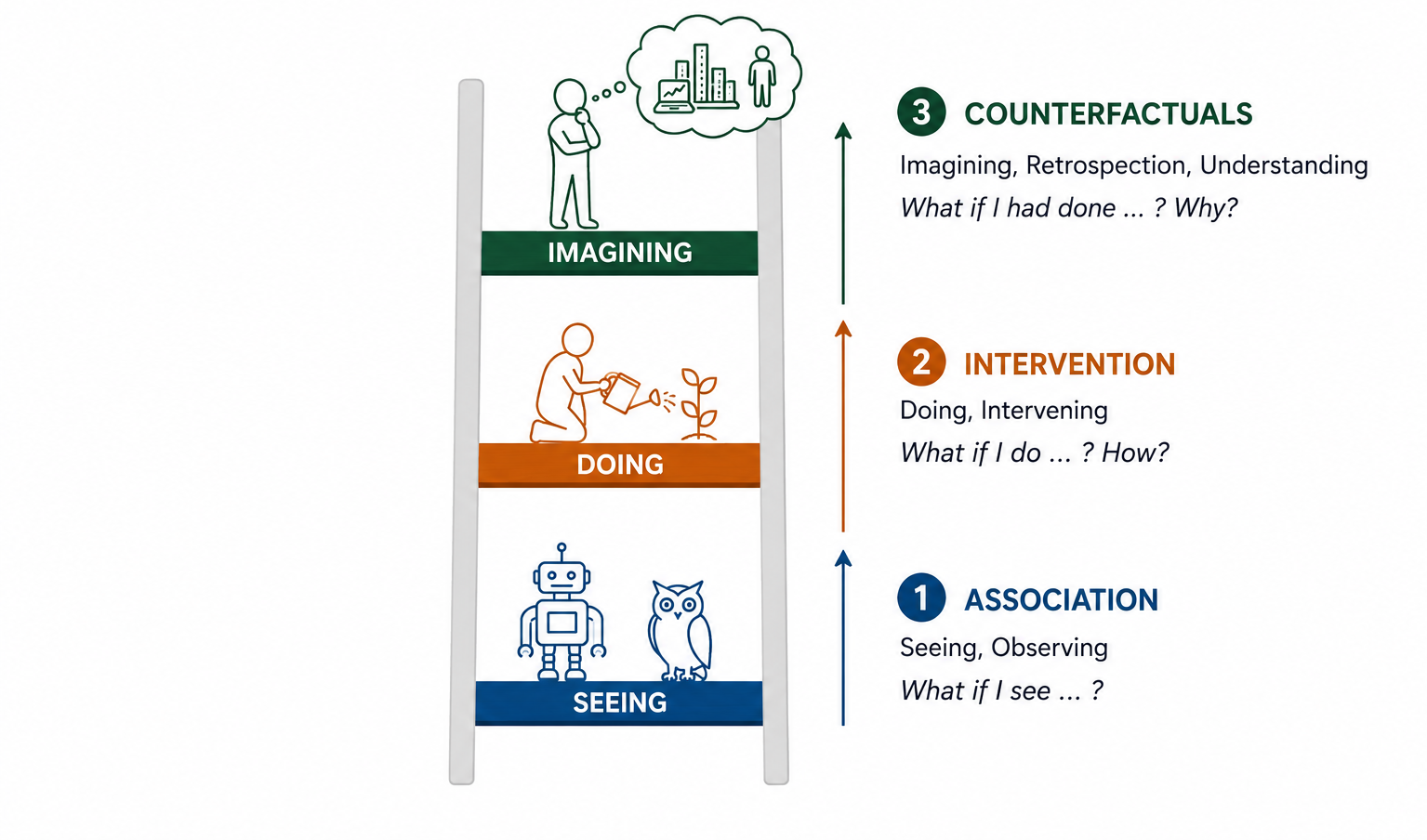
Cognitive primitives are the irreducible operations that any reasoning system must be able to perform, the atoms from which more complex inference is composed. In EARA's framing they map directly onto Pearl's three rungs.
| Primitive | Rung | Query form | What the LLM cannot do alone |
|---|---|---|---|
| Association | Rung 1 | P(Y|X) | Approximates this, but confounds cause and correlation |
| Intervention | Rung 2 | P(Y|do(X)) | Cannot compute, no model of mechanism |
| Counterfactual | Rung 3 | P(Yₓ | X=x′, Y=y′) | Cannot compute, requires structural equations + abduction |
These are primitive in the strict sense: none reduces to the others. You cannot derive intervention effects from association alone, that is the entire point of Simpson's paradox and confounding. You cannot derive counterfactuals from interventional distributions without structural equations and the twin-network method.
The practical implication: when a client asks "what would have happened if we hadn't launched that campaign," that is a Rung 3 query. An LLM alone will confabulate an answer. EARA routes it to the structural model and returns a defensible one.
02 The problem
It is tempting to treat the Bayesian network or SCM as the centrepiece. It is better seen as the knowledge substrate, while the real reasoning emerges from the collection of analyses operating on it. Without named, distinct cognitive functions, a model answers only one question: what is the posterior? That leaves six other enterprise questions unanswered: why is it true, which evidence mattered, what to learn next, whether to still trust the model, what happens under other futures, and what to do.
These are genuinely different cognitive functions, not variations on inference. A single posterior cannot serve them all. The suite can.
The dual-process reading. Pearl’s Ladder of Causation is a cognitive hierarchy. Rung 1, association, is what animals and statistical models do: fast, pattern-matching, reactive. Rungs 2 and 3, intervention and counterfactual, are what humans do when reasoning about actions and consequences: slow, deliberate, structured.
An LLM alone is a very sophisticated Rung 1 system. It can talk about Rungs 2 and 3 but cannot compute them. The Cognition component, the domain model plus the suite of cognitive primitives operating on it, is what makes Rungs 2 and 3 computable. The LLM handles language; the causal model handles cognition.
Each primitive taps the same domain model. That is the architecture’s key property: one elicited, auditable model, many reasoning services. The model does not change between primitives; only the question does.
03 The Seven Primitives
Cognitive Primitives is the Domain Models, The Model layer of EARA. It defines seven reusable reasoning services, each of which orchestrates inference operations over the shared domain model and produces a certified artifact. Every downstream component, Inquiry, Robustness, Validation, Pattern Analysis, Scenarios, Optimization, Monitoring, is an instantiation of one or more of these primitives.
Each primitive taps the same domain model. That is the architecture’s key property: one elicited, auditable model, many reasoning services. The model does not change between primitives; only the question does.
The .bayes file is the model. The primitives are the code layer that operates on it. The engagement delivers both.
| Primitive | The question it answers | Detail |
|---|---|---|
| Inquiry | What evidence would most change the decision? Computes Value of Information (VoI) for each unobserved variable; ranks by expected reduction in entropy. |
05 → |
| Robustness | How fragile is this conclusion? Perturbs CPT parameters within bounds and re-runs inference; measures sensitivity of conclusions. |
06 → |
| Validation | Does the model still reflect reality? Computes posterior predictive checks against held-out observations; flags calibration gaps between model beliefs and empirical frequencies. |
07 → |
| Pattern Analysis | Why does the model believe what it believes? Runs sensitivity analysis across all CPT entries; identifies which assumptions most strongly determine the current belief state. |
08 → |
| Scenarios | What does the model say across alternative worlds? Runs multiple forward/interventional inference passes under named scenario configurations. |
09 → |
| Optimization | What is the best action under constraints? Searches the action space using do-calculus; evaluates P(outcome|do(action)) across candidates. |
10 → |
| Monitoring | Should I still trust this model right now? Computes log-likelihood of incoming evidence against the model; flags anomaly scores and drift. |
11 → |
04 How it works
Evidence arrives as language and sensors. The LLM structures it as calibrated soft evidence, not hard facts. The domain model infers the hidden state. From that single explicit state the reasoning processes fan out, each tapping the same model to answer its own question.
Explain and Inquire are epistemic: they answer why the model believes what it believes, and what it should learn next. They operate on the current posterior.
Scenario and Optimize are action-oriented: they evaluate alternative futures and search for the best course of action. They operate on interventional distributions, Rung 2 and Rung 3 queries.
Monitor, Robustness, and Learn are meta-epistemic: they ask whether the model itself is still trustworthy. They are the checks that keep the domain model honest over time.
The boundary holds throughout: the language model sits only at the two ends. Discovery (upstream) feeds elicitation, never writing edges directly. Policy is applied, and the LLM narrates.
05 The Brains
The Cognitive Primitives page describes the brains in full, the seven operations that turn a domain model into a reasoning system. Each of the pages that follow (05 through 11) is one primitive in detail, with its own worked example and LLM dialogue.
There is no single .bayes file for Cognitive Primitives, the domain model is domain-specific and built through Discovery and elicitation. The primitives are the operations, not the model. Optionally open any domain-specific .bayes file in your inference tool of choice. The model is the thing; the software that runs it is a commodity.
06 Query in plain English
The same domain model answers seven different questions depending on which primitive is invoked.
Same model, seven primitives. Each page that follows is one primitive in full.
07 Where it sits
Cognitive Primitives is the architectural centrepiece of EARA. It sits between the domain model (built through Discovery and Evidence) and the governance layer (BPMN Integration). Every component numbered 05 through 11 is a named instantiation of one of the seven primitives.
Upstream: the domain model (the .bayes file, built via 02 Discovery and 03 Evidence) and the EvidenceBinding set from 01 Pipeline. Downstream: every primitive produces a certified artifact, a typed, versioned object, that feeds 12 BPMN Integration at the governance handoff.