Inquiry
Executive TechnicalA model that only reasons over the evidence it has is passive. The valuable move is reasoning about the evidence it does not have, and asking for the one piece that changes what you will do.
01 The Gap
More data is gathered. Most of it changes nothing.
Faced with a borderline call, the instinct is to gather more data. Most of it is wasted: it sharpens a number without changing the action. A system that treats “collect more” as a reflex produces accurate posteriors nobody acts on differently.
Not which test is most accurate: which most changes the decision. Accuracy and decision-relevance come apart constantly. A highly accurate test whose result would not alter the treatment is worth nothing; a noisier one that flips the call is worth everything.
02 The component
Value of Information, ranking observations by what they would change.
Inquiry is a Cognitive Primitives, Epistemics component. It operationalises Value of Information (VoI): for each thing the system could measure, how much would knowing it change what gets decided? It takes the current posterior and the decision threshold as inputs, and returns a ranked list of candidate observations scored by their expected effect on the decision, not their accuracy.
| Field | What it holds |
|---|---|
| Current posterior | Where the model stands right now, given evidence so far |
| Decision threshold | The probability that would actually change what you do next |
| Ranked probes | Which test or question to order next, ranked by expected swing in the decision, not by how uncertain the model currently is about it |
VoI is a Rung 1 computation over the model’s structure, it asks what the posterior would be under each possible observation, weighted by how likely that observation is. It does not require collecting the data. It ranks what is worth collecting.
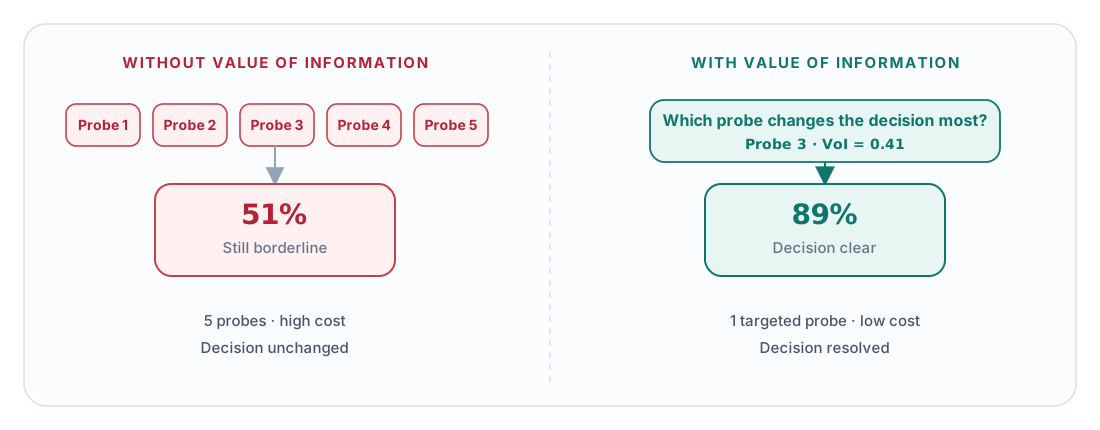
Value of Information finds the one question worth asking. Gathering everything is expensive and often leaves the decision unchanged. One targeted probe, the one the model says matters most, is usually enough to resolve a borderline call.
03 How it works
Infer the current state. Compute the best probe. Ask for exactly that one.
The loop is: infer the current state, compute which probe is worth the most, ask for exactly that one, take the answer, and re-infer. This closes a loop the other capabilities do not.
Infer. The model computes the current posterior given available evidence.
Value. For each candidate observation, the model computes the expected reduction in decision uncertainty if that observation were made. Output: a ranked VoI list.
Ask and re-infer. The top-ranked probe is requested. The answer arrives as a new EvidenceBinding, the posterior updates, and the loop continues until the decision threshold is crossed.
The boundary holds: the LLM proposes the question in natural language; the VoI computation is symbolic and deterministic; the answer re-enters as a typed EvidenceBinding.
04 The Brains
The model reasoning about its own uncertainty.
Inquiry is what happens when the model reasons about its own uncertainty, not just what it knows, but what it needs to know next.
There is no .bayes file for Inquiry, Inquiry is an operation on any domain model, not a domain-specific model itself. The artifact it produces is an InquiryResult: a ranked list of candidate probes by expected decision value.
| Field | Value |
|---|---|
| Current posterior | P(Sepsis) = 0.63, borderline against the 0.7 decision threshold |
| Top-ranked probe | Order a Lactate test, expected to move the decision more than any other available test (VoI 0.64) |
05 Query in plain English
Not what is true, what to ask next.
Inquiry answers the question a passive inference engine cannot: what to ask next.
The audit trail is the InquiryResult, not the clinical instinct.
06 Where it sits
Downstream of initial inference, upstream of the decision.
Inquiry is the first Cognitive Primitives, Epistemics component. It sits downstream of the initial inference (which gives the current posterior) and upstream of the decision (which consumes the final posterior). It feeds back into the Pipeline: the probe it recommends becomes a new query, which produces a new EvidenceBinding, which updates the posterior.
Upstream: the current posterior from Execute (01 Pipeline stage 6). Downstream: the next EvidenceBinding request, which re-enters at Parse (01 Pipeline stage 1). Inquiry interacts with Optimization (10) when the probe is not just an observation but an action.