Healthcare
Executive TechnicalWhich exposure caused this patient’s outcome, separated from the confounders that made it look more or less likely, answered per patient, not on the average.
The Healthcare plug-in, vocabulary, structure, and the questions your leaders ask, already mapped. Nothing here starts from a blank page.
The QuestionDid this exposure cause this patient's outcome, or just correlate with it?
The MethodA structural causal model with explicit confounders, computing the probability of necessity per patient.
The AnswerA per-patient causal attribution, not a population average standing in for an individual case.
01 The Decision
PHARMACOEPIDEMIOLOGY has a well-developed Rung 2 toolkit. Cohort studies, case-control studies, self-controlled case series, target-trial emulation, these all answer the population-level question: across many patients, how does drug exposure shift the distribution of an adverse outcome? That is sufficient for regulatory approval and for population-level risk-benefit analysis.
It is not sufficient for the individual question that drug-injury cases, M&M conferences, and causality-assessment frameworks (WHO-UMC, Naranjo, RUCAM) ask: in this specific patient, with this specific exposure, did the drug cause the injury? That is a Rung 3 counterfactual claim, and answering it requires structural commitments that go beyond what a Bayesian network can offer on its own.
A standard Bayesian network can compute P(AKI | NSAID, covariates) at Rung 1 and P(AKI | do(NSAID), covariates) at Rung 2. It cannot, by itself, compute P(AKI = No | do(NSAID = No), this patient’s observed factual outcome and covariates), the probability of necessity, the formal version of “but-for cause.” That computation requires committing to a structural-equation interpretation of the graph, with explicit exogenous variables that absorb the residual variation. Those exogenous variables, the U-nodes, are abducted from the factual observation, the intervention is applied, and the counterfactual outcome is read.
02 The solution
The model is a Structural Causal Model in the strict sense: every endogenous variable has its structural parents AND a corresponding exogenous U-node. The U-nodes are not optional cosmetic additions, they are what makes the counterfactual computation tractable.
| Node | States | Role |
|---|---|---|
| BaselineRenalFunction | Normal · CKD_stage_2_3 · CKD_stage_4_plus | Pre-existing risk |
| SurgeryType | Minor · Major · None | Acute insult |
| PeriOpDehydration | Low · Moderate · High | Modulator |
| ConcomitantNephrotoxin | None · Vancomycin · IV_Contrast · Multiple | Co-cause |
| NSAID_Exposure | Yes · No | Exposure of interest |
| IntraopHemodynamics | Stable · Hypotensive | Mediating variable |
| AKI_outcome | Yes · No | Adverse event of interest |
Each observable also has a U-node, U_NSAID, U_AKI, etc., modeled as a 2-state exogenous variable with a 50/50 prior. These U-nodes are the residual variation that structural parents do not explain. Edges: BaselineRenalFunction, SurgeryType, PeriOpDehydration → IntraopHemodynamics. IntraopHemodynamics, NSAID_Exposure, ConcomitantNephrotoxin, BaselineRenalFunction → AKI_outcome. Optionally: BaselineRenalFunction → NSAID_Exposure (CKD reduces NSAID prescribing, confounding by indication in the protective direction).
The solution was to model the relationships between the variables that determine adverse event risk, and to be explicit about which variables cause which. We recognised, for example, that NSAID exposure does not operate independently of baseline renal function, the same exposure produces very different risks depending on what was already true about the patient, which means observing an adverse outcome tells you something about both the exposure and the pre-existing conditions that modulated it. Surgery type, perioperative dehydration, and concomitant nephrotoxins all contribute to the outcome, but through different mechanisms that a regression coefficient cannot separate. When you observe a variable in this model, you are effectively filtering the data to cases where that variable takes a particular value, and that filter ripples through the model, shifting related variables up and down accordingly. When you intervene on a variable, forcing it to a value regardless of what caused it, you break that ripple effect and get a cleaner answer: not what patients who look like this tend to experience, but what would have happened if this specific exposure had been absent When you abduct, you extract a particular case from the averages, locking in its idiosyncratic circumstances before asking what would have happened if one or more things had been different.
Rung 2 is identifiable under standard back-door adjustment. Rung 3, the probability of necessity, is identifiable given the SCM structural assumptions: that U-nodes are independent across observables, that structural equations are deterministic given (parents, U), and that the parameterization is correct. Rung 3 always requires assumptions that go beyond what data alone can support, and naming those assumptions is a precondition for using the inference responsibly in a regulatory or legal context.
03 What the solution answers
Among patients with this covariate profile who took the NSAID, what fraction developed AKI? Clinicians prescribe NSAID_Exposure less in patients with CKD, precisely because they fear AKI. The covariate is informative about both the outcome AND the prescribing decision. The conditional cannot tell you which is which.
This patient profile shows a 56% AKI rate after NSAID exposure. That number is misleading because clinicians already steer NSAID use away from CKD patients, so the apparent association mixes drug effect with patient selection.
If we forced NSAID exposure on a random patient, without conditioning on the prescribing rule, what would the AKI rate be? The do-operator severs the BaselineRenalFunction → NSAID_Exposure edge, breaking the back-door from CKD into the prescribing rule. This is the standard regulatory question, sufficient for label warnings and prescribing guidelines.
The actual causal effect of NSAID exposure across the population is +9.3 percentage points in AKI risk. That’s real, and it justifies the label warning, but it does not tell us whether the NSAID caused this specific patient’s AKI.
This patient took the NSAID and developed AKI. Would the AKI have occurred if they had not taken the NSAID? Three operations on the same graph: (1) set the patient’s full evidence, U_AKI’s posterior shifts away from 50/50, encoding this patient’s idiosyncratic AKI susceptibility. (2) Carry the abducted U_AKI forward as soft evidence. (3) Apply do(NSAID_Exposure = No) and read the counterfactual outcome.
For this specific patient, the model estimates a 50% chance the AKI would have occurred even without the NSAID: given their CKD, major surgery, and intraoperative hypotension. So the probability of necessity, the strength of the claim that the NSAID caused this AKI, is 50%. That’s a defensible patient-specific attribution.
04 Inside the Model
A language model can speak fluently about any domain. It cannot know one. The .bayes file is the knowledge the LLM is missing: a causal map of the domain, auditable, versioned, and wrong in specific correctable ways.
Optionally open PharmacovigilanceAttribution.bayes in Bayes Server or any equivalent tool. The model is the thing; the software that runs it is a commodity.
A black checkmark = observed evidence. A red checkmark = do() intervention (severs incoming links; parents stay at prior).
Rung 1, Association: confounding by indication
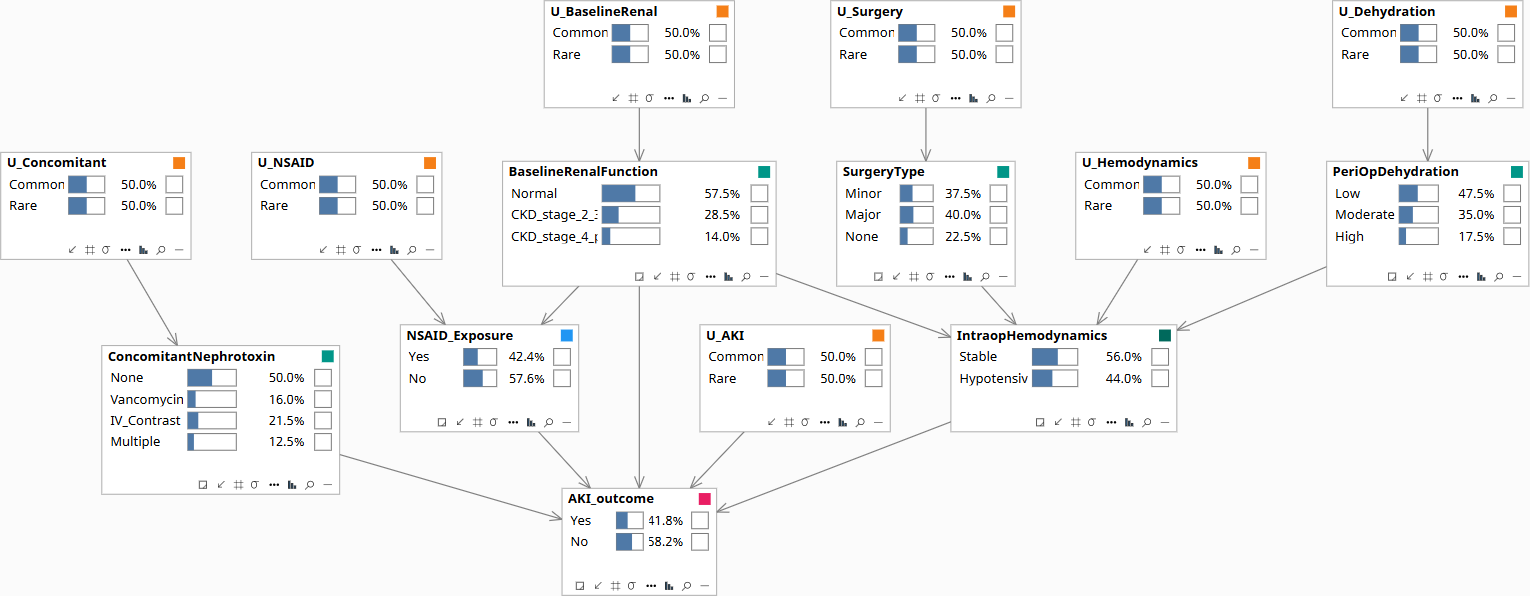
Population baseline before any patient data is entered. AKI, NSAID exposure, and covariates all sit at their marginal priors.
Rung 2, Population effect: do() vs obs() on NSAID
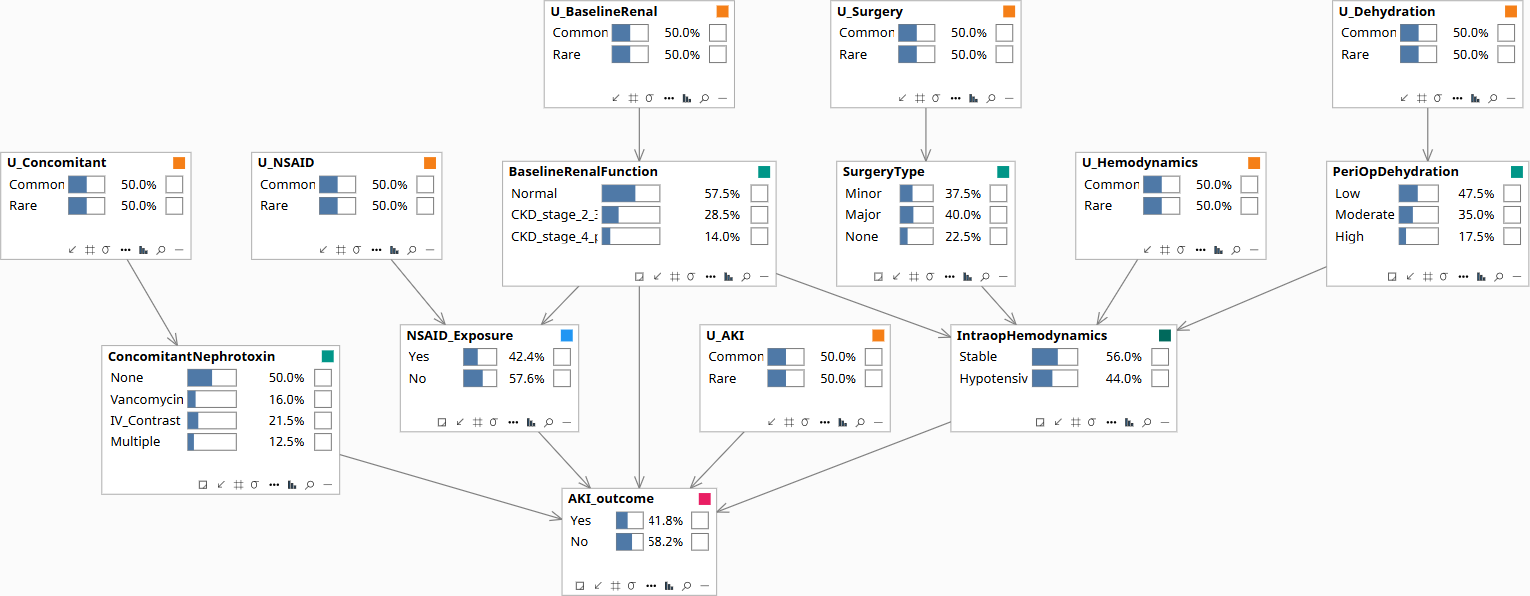
Population baseline. NSAID is at its prior, some patients exposed, most not, driven by the natural prescribing rule that depends on renal status.
Rung 3, Individual counterfactual: did the drug cause this patient’s injury?
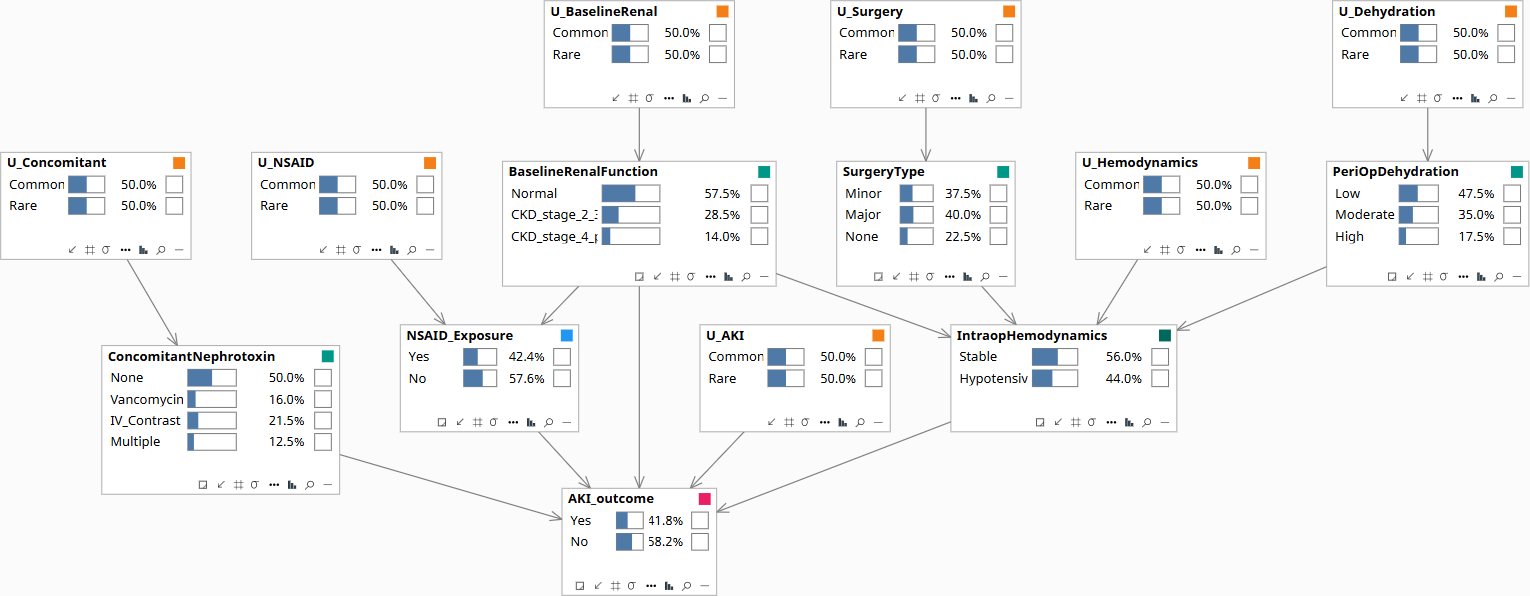
Population baseline before any patient data is entered. All nodes at their marginal priors.
05 Just Ask
The model is a file. Any capable LLM can load its XML and answer pharmacovigilance questions in plain English, keeping association, population effect, and individual counterfactual apart.
Same model, three rungs, driven in conversation. The audit trail is the .bayes file, not a black box.
- Cohort-level policy. Would restricting this exposure hospital-wide reduce adverse events?
- Dosing threshold. At what exposure level does the causal risk cross an actionable threshold?
- Confounder audit. Which currently unmeasured factor would most change the attribution if added?
- Comparative attribution. How does this patient's causal risk compare to a matched cohort?
- Regulatory reporting. What is the population-attributable fraction for this exposure this quarter?
06 The Engagement
Encode your clinical team’s pharmacovigilance reasoning into an SCM: which risk factors interact, which are legally material in your jurisdiction, and which are noise. The resulting model applies that reasoning consistently at scale, and produces defensible, patient-specific attributions your M&M committee and legal team can work with.
PharmacovigilanceAttribution.bayes
Structural Causal Model with explicit U-nodes for each observable. The U-nodes are essential, they are what makes counterfactual abduction possible: from the factual observation (this patient, this exposure, this outcome) the U-values are inferred, then a do-intervention is applied, and the counterfactual outcome is read. The probability of necessity, the formal version of ‘but-for cause’, is what the model computes.
This case study is a composite drawn from published pharmacoepidemiology, the study of how drugs affect populations, literature and pharmacovigilance causality assessment frameworks. Specific figures are representative. No individual patient or engagement is described. The Bayes Server models are working files: download, set evidence, and run inference.
The Deeper Trade
The model does not replace the expert who built it. It frees her from being the bottleneck for every routine version of this question, so she can spend her judgment on the cases that actually need it, and keep making the model better.