The Engagement
ExecutiveEight weeks, three phases. What you provide, what lands on your desk at the end, and the smallest version worth funding.
Executive Summary
An engagement runs eight weeks across three phases: elicitation, calibration, and delivery. You provide a few hours of your experts’ time per week and a single decision domain to focus on. In exchange, you receive a working causal model, the language interface connecting it to your existing AI, and the governance record behind every answer it produces, all owned outright, none of it dependent on this practice’s continued involvement. The smallest fundable version is one model on one decision; everything else scales from there.
01 What You Are Buying
Not software. There is no product to license and no platform to log into.
You are buying a working causal model of one part of your business, built from what your own experts know, plus the connection that lets your existing AI use it, the difference between an AI that talks and one that actually reasons. At the end you hold the model, the reasoning behind every number in it, and the ability to maintain it yourself.
The rest of this site explains the architecture. This page explains what happens, what it costs you in time, and what lands on your desk at the end.
02 The Eight Weeks
A first engagement runs in three phases. The first five weeks are fixed. Handover begins in week six and runs as long as skill transfer takes.
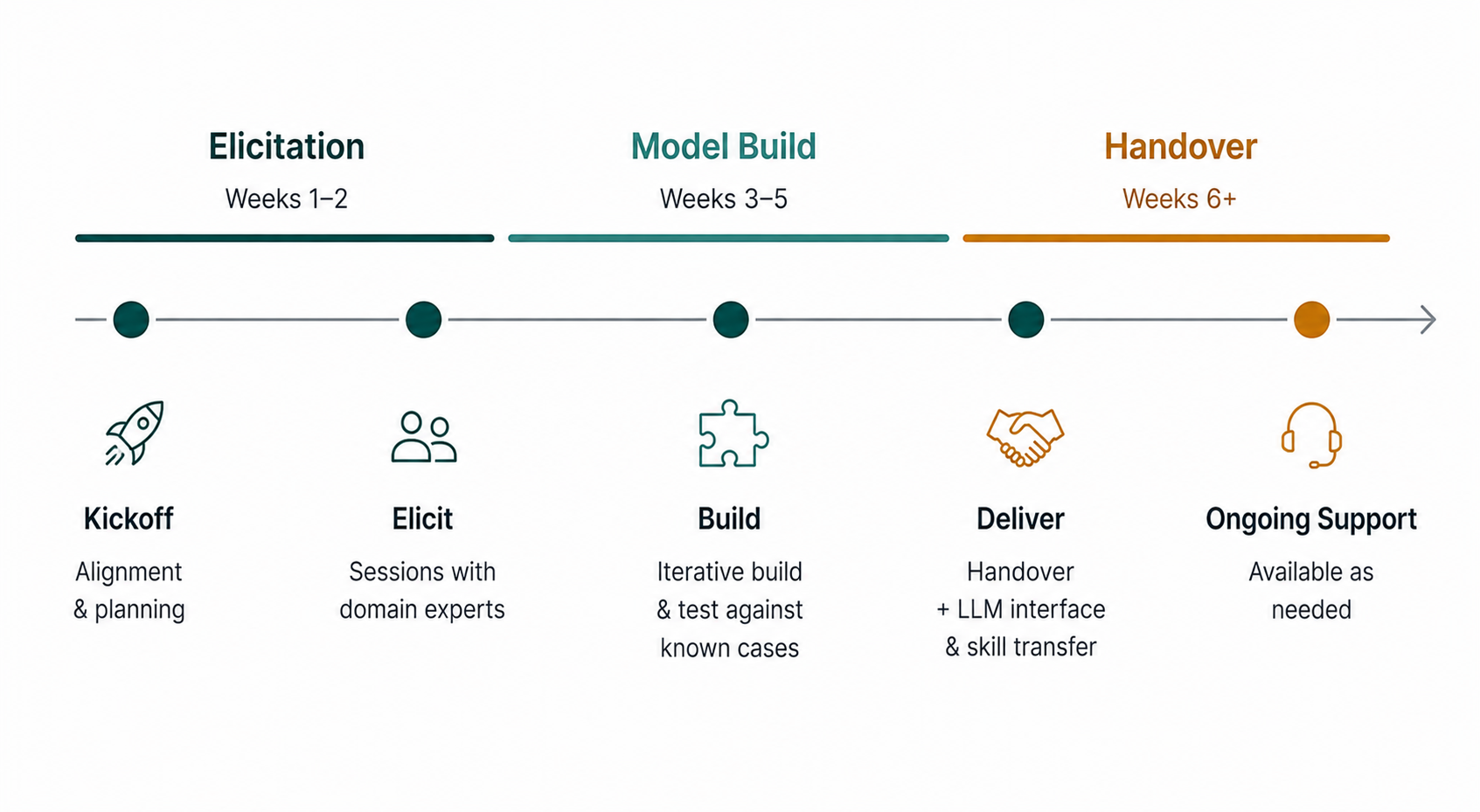
Kickoff and expert sessions. We agree the decision the model has to support and who the experts are. Then the sessions begin: structured interviews that draw out how your people believe the system actually behaves. This is the phase that determines whether the whole thing works.
Build and test. The elicited knowledge becomes a working model, tested against cases where you already know the answer. Where the model disagrees with a known outcome, we go back to the experts. The disagreement is usually informative rather than an error.
Delivery and skill transfer. The model is connected to your language model so people can ask questions in plain English. Your team is trained to run it, read it, and change it. Support after that is available as needed, not required.
You see something real in week three: a draft causal map your experts can argue with, which is the point at which most sponsors know whether this is going to work.
03 What You Provide
Expert time is the real cost. Plan on four to six people, and roughly six to ten hours each across weeks 1–2, in sessions rather than one long block. These need to be the people who know how the system behaves: the underwriter who has seen which claims go bad, the engineer who knows which failures cascade. Not their managers, and not whoever has the most availability.
A sponsor who can settle disagreements. Experts will contradict each other. That is normal and useful, but somebody has to decide when the model has to pick one. Every engagement is sponsored at Managing Director level or above for this reason.
Whatever data you have, but not more than you have. Data is used to check and refine the model, not to build it. A shortage of data is the usual reason for choosing this approach, not a reason against it.
04 What You Get
Every item below is a file or document you own. Each one links to a real worked example on the Deliverables page.
The Model Itself
The causal map: a diagram of what drives what in your business, reviewed and signed off by the named experts. Readable by anyone; this is the artifact executives use.
The model file: runs in Bayes Server. It is yours. There is no licence to me and no dependency on my continued involvement.
A scope card: a plain statement of what the model covers: which factors, which population, and which kinds of question it can answer. It defines the model’s boundary so nobody applies it where it does not belong.
The Evidence It Works
Validation report: what was checked mathematically and what was checked against real outcomes, reported separately. Where only the first was possible, the report says so.
Robustness report: which conclusions still hold if an expert’s estimate was wrong. This is the section a regulator reads first.
Elicitation records: where every number came from and who supplied it. Provenance for the whole model.
Using and Keeping It
A worked question set: real questions from your business, run end to end, each with the full record of how the answer was reached.
The runbook: how to add a factor, re-run the elicitation, and tell when the model needs revisiting.
The list is deliberately specific so you can hold me to it. Ask for the same list from anyone else you evaluate. See the full Deliverables page for one real example of each.
05 The Smallest Version
Nobody should fund the full picture first. The smallest engagement I take is $50,000, and it buys the engagement described above applied to one decision in one domain.
That deliberately narrow scope is the point. One model, one clearly defined decision, the complete artifact set. It is enough to answer the only question that matters at this stage: does the method work on our problem, with our people, in our regulatory environment?
Choose a decision that is real but not existential. It should matter enough that people will show up to the sessions, and be contained enough that a single build is sufficient. If you are unsure which of your problems fits that description, that is a reasonable first conversation.
06 What Happens When I Leave
Fair question to ask a one-person practice, and the answer is built into how the work is done.
The model runs in Bayes Server, which is commercially supported software you licence directly, not from me. The model file is a standard format. The causal map is a diagram your own experts approved and can read. The runbook covers maintenance. Skill transfer happens from week six rather than being promised for later.
What you cannot get back is the elicitation itself, which is why the records are part of the deliverable. If you re-elicit in two years, you start from what your experts said last time rather than from nothing.
Ongoing support is available. It is not required, and an engagement that leaves you needing it has not been done properly.
Engagements fail on expert availability, not on technical difficulty. Everything else in this plan is negotiable. That part is not.