Litigation
Executive TechnicalWhich pathway drove the outcome, what a bias-free process would have produced, and whether this plaintiff would have been promoted but-for gender.
The Litigation plug-in, vocabulary, structure, and the questions your leaders ask, already mapped. Nothing here starts from a blank page.
The QuestionWould this plaintiff have been promoted but-for gender?
The MethodA causal model separating the legitimate decision pathway from the biased one, evaluated counterfactually.
The AnswerA but-for standard causal answer, the actual legal test, not a correlation-based proxy.
01 The Decision
COURTS REQUIRE BUT-FOR CAUSATION. The standard is explicit: the plaintiff must show that the harm would not have occurred but for the defendant’s action. That is a counterfactual claim. It belongs on Rung 3 of Pearl’s ladder. The analyses presented as expert evidence, regression models, trend extrapolations, difference-in-differences, are Rung 1 at best. They describe what correlates with what. They do not answer what would have happened in a world where the defendant acted differently.
The gap appears in three recurring litigation contexts, each with the same structural flaw:
Did this selection decision cause disparate impact, or did the candidate pipeline arrive already skewed?
But-for the breach, what would the plaintiff’s revenue have been? A trend line is not a counterfactual.
Was this plaintiff’s harm caused by this exposure, or by a pre-existing condition that was already progressing?
The opposing expert’s regression cannot answer the but-for question. That is not a methodological criticism, it is a category error. Regression estimates average associations across populations. But-for causation is a claim about a specific individual in a specific counterfactual world. A structural causal model can answer that question. A regression cannot.
02 The solution
The case modelled is a senior promotion decision in a financial services firm where a female candidate was passed over. The causal graph makes the structural question precise by separating four pathways through which the outcome could have been determined, and four intervention points, all of which have confounding parents so that do() and obs() produce meaningfully different answers.
OrgCulture, ManagerTenure → ManagerBiasScore
HistoricalHiring, IndustryNorms → PipelineComposition
HRBudget, LeadershipCommitment → StructuredInterview
HRBudget, DEIPolicy → BlindCV
# Pathways to outcome
PipelineComposition → CandidatePool → SelectionDecision
Gender → SelectionDecision (direct, weight 0.90)
Qualifications → SelectionDecision (merit, weight 0.50)
ManagerBiasScore → SelectionDecision (bias, weight −0.80)
StructuredInterview → SelectionDecision (process control, weight +0.40)
BlindCV → SelectionDecision (screening control, weight +0.30)
SelectionDecision → Outcome
Every intervention node has confounding parents: so do() is meaningfully different from obs(). The critical example: organisations that voluntarily adopt StructuredInterview tend to be better organisations with lower ManagerBiasScore. obs(SI=1) therefore conflates the intervention effect with the better-org selection effect. do(SI=1) forces adoption in any org, regardless of HRBudget or LeadershipCommitment, which is the policy mandate scenario. That gap (0.58 observed vs 0.38 mandated) is the confounding quantified.
The solution was to model the relationships between the variables that drive the selection decision, and to be explicit about which variables cause which. We recognised, for example, that a manager’s bias score is not a standalone fact, it reflects the culture of the organisation and the tenure structures that shaped it. Pipeline gender composition reflects historical hiring patterns and the norms of the industry. The adoption of structured interviewing and blind CV screening are both driven in part by how much the organisation invests in HR, which is why companies that voluntarily adopt one tend to adopt the other, and why both show up alongside lower bias scores in the data. That shared driver is a confounder: it makes organisations that voluntarily adopt these practices look more effective than a mandate would be. When you observe a variable in this model, you are effectively filtering the data to cases where that variable takes a particular value, and that filter ripples through the model, shifting related variables up and down accordingly. When you intervene on a variable, forcing it to a value regardless of what caused it, you break that ripple effect and get a cleaner answer: not what organisations that look like this tend to do, but what would happen if this specific thing were changed When you abduct, you extract a particular case from the averages, locking in its idiosyncratic circumstances before asking what would have happened if one or more things had been different.
The U_SelectionDecision node is the abduction target for Rung 3. It absorbs the background conditions specific to this plaintiff’s case, the particular panel, role, and date. Once anchored, do(Gender = Male) replays the decision in the counterfactual world. That is the but-for answer.
03 What the solution answers
obs(Gender = −1, Qualifications = 1.2, ManagerBiasScore = 1.0, Outcome = Not promoted). Given these observations, which upstream pathway is most consistent with the result?
A highly-qualified female candidate not promoted under a biased manager concentrates the posterior on the direct bias pathway. OrgCulture and ManagerTenure update upward, this is not an isolated incident but a systemic pattern. The pipeline pathway contributes less: CandidatePool composition updates only modestly because the plaintiff’s qualifications were above the pool median. The merit pathway is ruled out by the Qualifications evidence.
Four interventions are available. Each has a different causal mechanism and a different answer to “would this have helped?”
| Intervention | obs(=1) | do(=1.5) | Gap |
|---|---|---|---|
| ManagerBiasScore = 0 | , | 44% | Largest single effect. Mandatory structured process eliminates bias pathway directly. |
| StructuredInterview | 58% | 38% | 20pp gap. Voluntary adoption selects better orgs. Mandate works but less than observed data implies. |
| BlindCV | ~52% | 34% | Removes gender signal from initial screen. Smaller effect than SI because bias re-enters at interview stage. |
| PipelineComposition = 0 | , | ~28% | Pipeline parity alone leaves direct bias pathway intact. Necessary but not sufficient. |
Baseline: female high-qual candidate, MBS=1.0, no interventions: 22% promotion probability.
Abduct U_SelectionDecision and U_Outcome from the plaintiff’s actual case. Then apply do(Gender = Male) with all other conditions held, same panel, same role, same ManagerBiasScore, same qualifications.
Counterfactual promotion probability: 69%. In a world where the plaintiff presented identically but as male, she would have been promoted with 69% probability. That is the probability of necessity: the legal but-for standard expressed as a causal quantity with explicit, auditable assumptions. It is not a certainty. It is the honest answer.
04 Inside the Model
A language model can speak fluently about employment discrimination law. It cannot know whether this plaintiff’s case satisfies the but-for standard. The .bayes file is the knowledge the LLM is missing: a structural encoding of the selection process, with explicit pathways for pipeline composition, direct bias, merit, and idiosyncratic background.
Optionally open EmploymentDiscrimination.bayes in Bayes Server or any equivalent tool. The model is the thing; the software that runs it is a commodity.
Rung 1, Diagnostic: what does the non-promotion imply about the process?
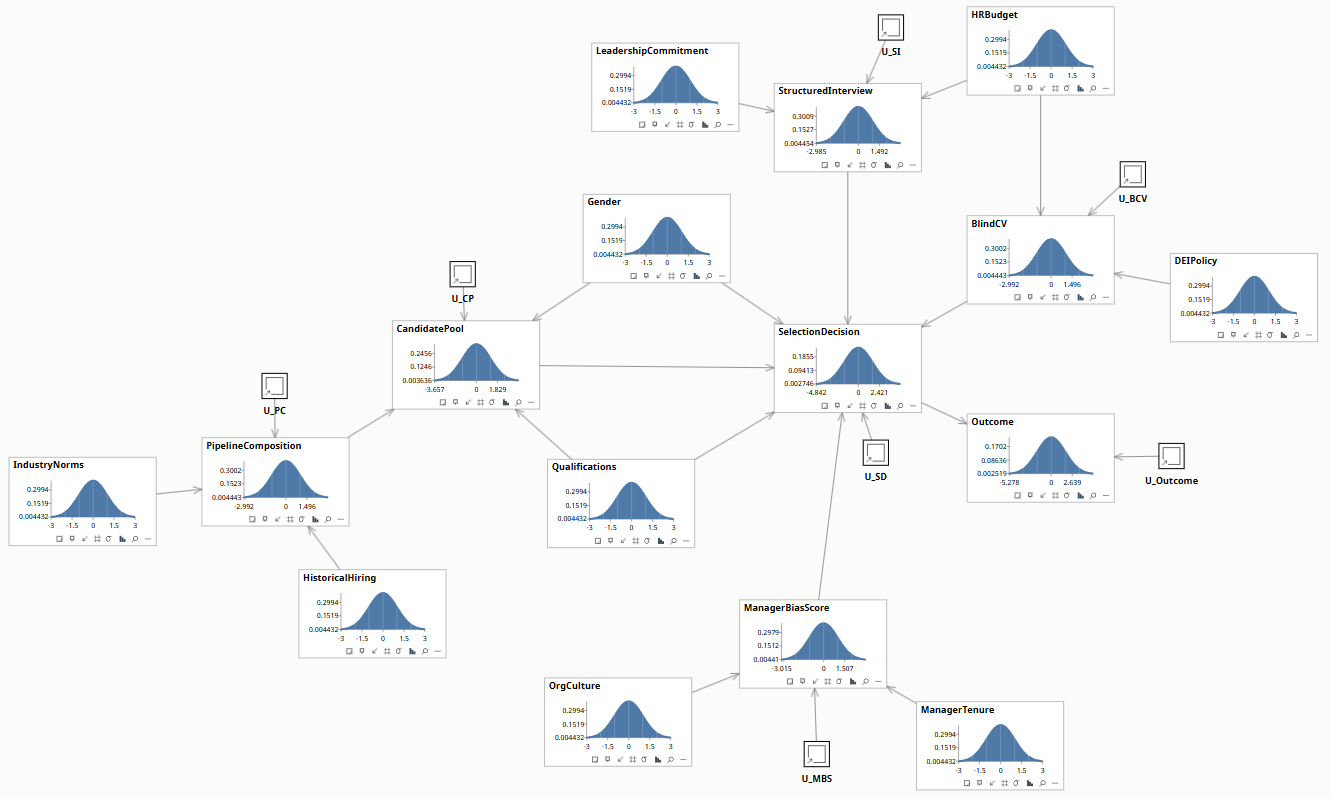
Baseline. All pathways at prior. SelectionDecision reflects the population mix of bias and merit.
Rung 2, Intervention: what does a bias-free process produce?
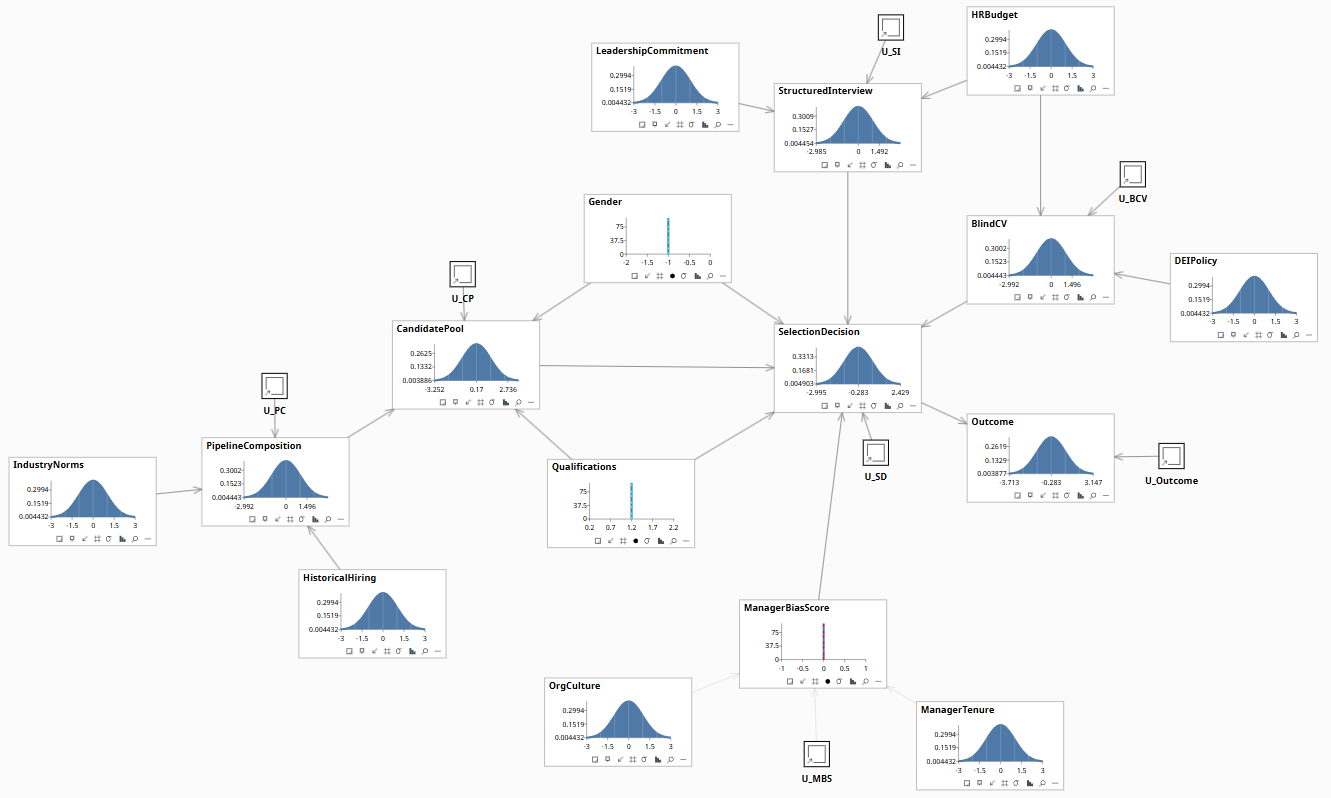
Forcing ManagerBiasScore to zero severs the direct gender bias pathway. Promotion rate for highly-qualified female candidates rises from 16% to 42%, a 26pp causal effect of the bias component.
Rung 3, Counterfactual: would this plaintiff have been promoted but-for gender?
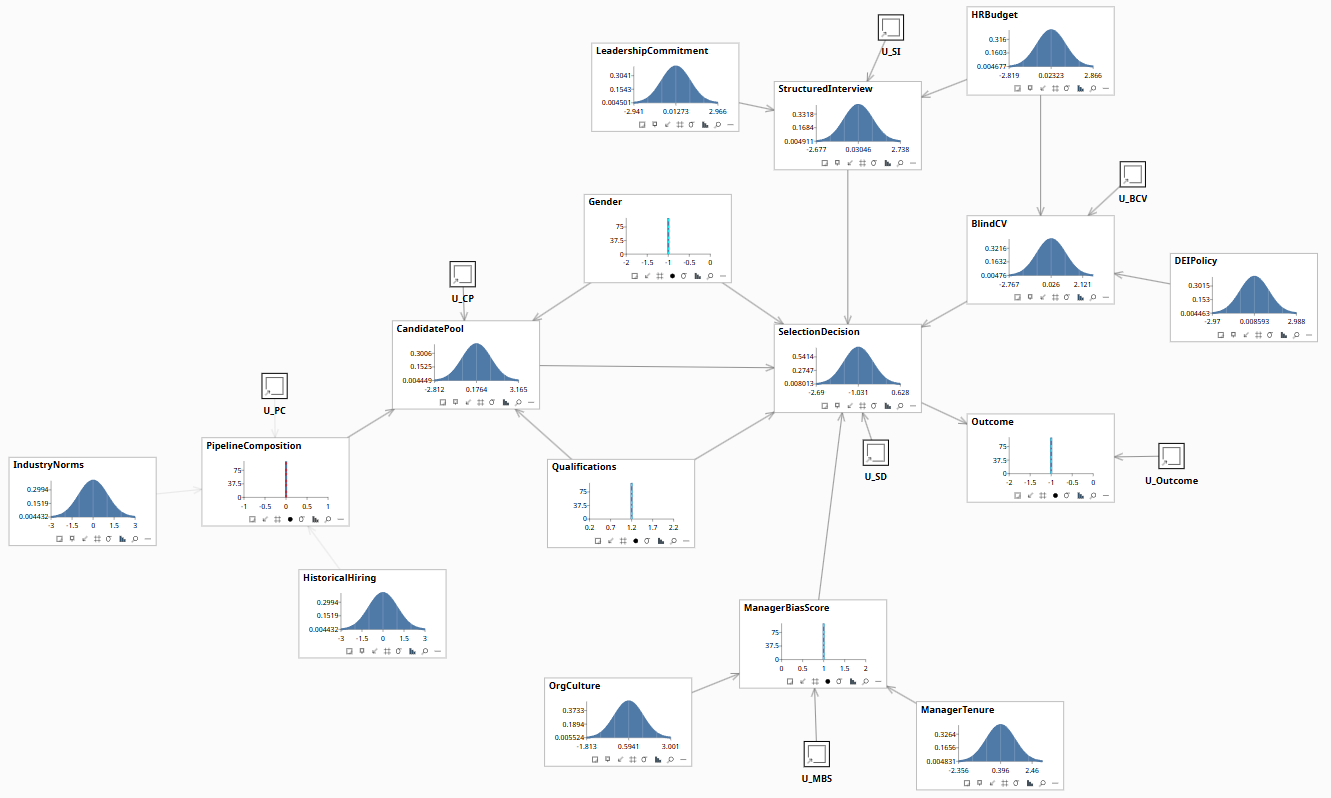
Plaintiff’s actual case entered: Female, High qualifications, Not promoted, this panel, this role. U_Selection anchored to this specific decision. Ready for counterfactual.
05 Just Ask
The model is a file. Load it into any capable LLM and the but-for question becomes a query.
Same model, three rungs. The audit trail is the .bayes file, not the regression output. Every assumption is explicit and challengeable.
- Class-wide exposure. Does the same pathway bias apply across the broader employee population?
- Remediation design. Which policy change would close the causal gap going forward?
- Damages calculation. What is the expected value of the promotion or raise that would have occurred?
- Comparable roles. Does the same bias pathway appear in a different job family?
- Onset detection. When did the causal gap first become detectable in the data?
06 The Engagement
Litigation support is structured around the expert report and deposition. The causal model replaces or supplements the regression analysis with an approach that answers the legal question the court is actually asking.
- Expert witness support. Build the structural causal model that answers the but-for question directly. The model is the exhibit: transparent, auditable, and defensible under cross-examination in a way that a regression is not.
- Opposing expert critique. Identify the specific causal question the opposing regression fails to answer. A methodological objection grounded in the ladder of causation is harder to rebut than a statistical quibble.
- Remedial analysis. For employment discrimination, do(bias = 0) produces the counterfactual promotion rate that a structured selection process would have generated, the number that drives the damages calculation.
- Individual plaintiff analysis. The Rung 3 abduction-plus-intervention answers the but-for question at the individual level, not just the population level. That is the question wrongful termination, personal injury, and lost profits cases actually require.
This case study is a composite drawn from published employment discrimination litigation and causal inference literature. The structural equations and figures are illustrative. No individual case, organisation, or individual is described. The model represents the analytical approach, not the facts of any specific matter.
The Deeper Trade
The model does not replace the expert who built it. It frees her from being the bottleneck for every routine version of this question, so she can spend her judgment on the cases that actually need it, and keep making the model better.