Security Operations
Executive TechnicalA SOC does what a clinician does: assemble weak signals over time into a judgment about a hidden state. That is a causal-inference problem, and it is the same architecture, pointed at the kill chain.
01 The Gap
Detection asks “is this alert malicious?” The real question is “what is the attacker doing?”
Most detection asks a local question, is this alert malicious?, one event at a time. The question a defender has is global and temporal: given everything seen across logins, endpoints, network, and threat intel, is an attack progressing right now, and how confident is the answer? Signature-based detection cannot answer that question. It was not designed to.
Signatures detect the known. Attackers change the moment you watch for them. The moment a new technique is signed, it is retired. The causal structure of an intrusion, phishing enables credential theft which enables privilege escalation which enables lateral movement which enables exfiltration, changes far more slowly than the individual techniques. That structure is what the model encodes.
02 The component
The full EARA stack applied to the kill chain, no new components needed.
Security Operations is a Cross-Cutting domain application of EARA, not a new architectural component, but the full EARA stack applied end-to-end to security operations. The domain model encodes the kill chain as a dynamic causal model. The LLM normalises raw telemetry into EvidenceBindings. The Cognitive Primitives answer: what is the current compromise probability, what evidence would most change the assessment, and what action most reduces risk?
Phishing → CredentialTheft → PrivilegeEscalation → LateralMovement → Exfiltration
↓ ↓
AccountCompromise DataExfiltration
// Evidence enters as soft bindings from the LLM
SoftEvidence("VPNAnomaly", p=0.71) # LLM read of the log
HardEvidence("PrivilegeEscalation", "confirmed") # EDR alert
The structure is elicited from your security experts, not mined from breach data you hope resembles the next breach. The same elicit-don’t-learn stance as every other EARA model.
03 How it works
Evidence lands. The posterior climbs. Policy acts on probability, not log lines.
Reading the evidence. The LLM normalises raw telemetry, log lines, alerts, threat intel, into typed EvidenceBindings, preserving confidence as soft evidence. It does not classify events; it translates them. The classification is the model’s job.
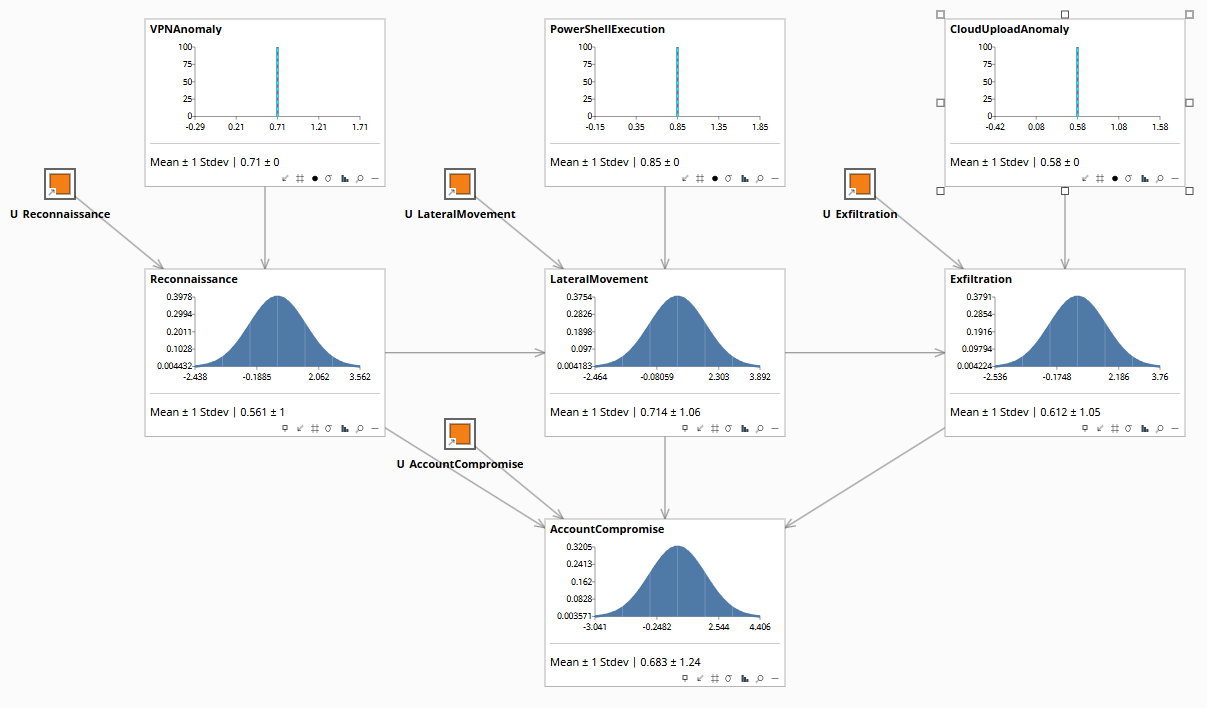
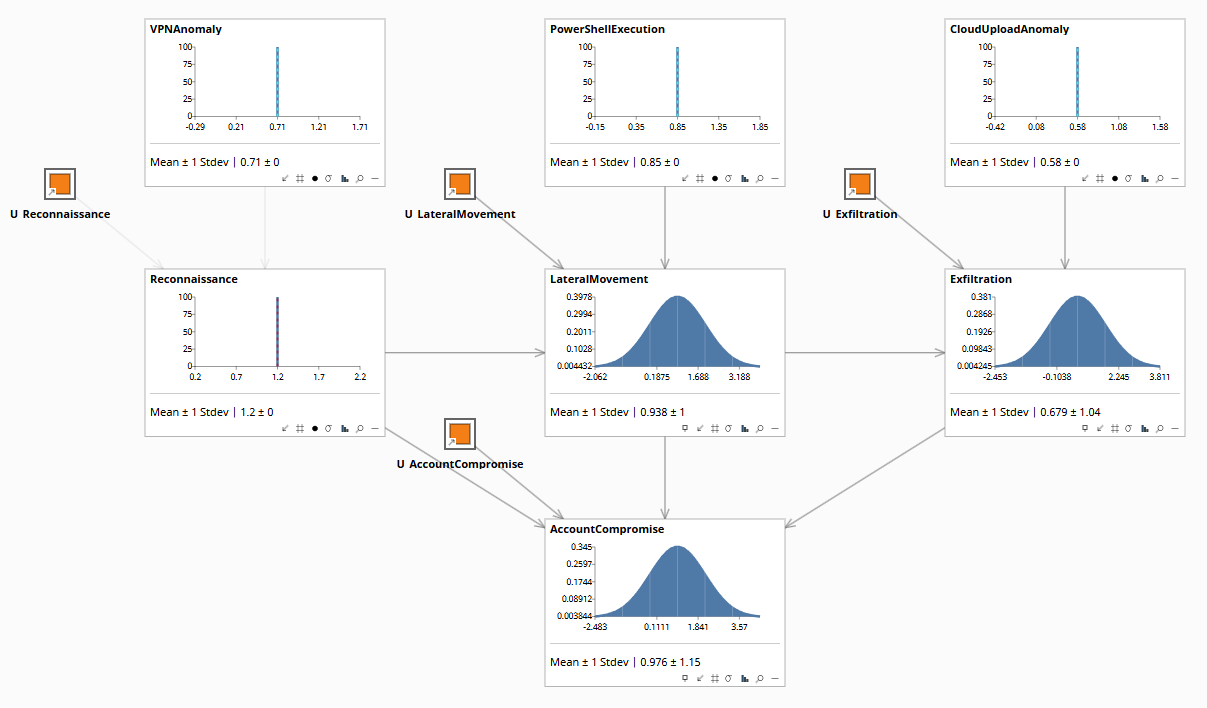
Running the posterior. As evidence lands, P(AccountCompromise) updates continuously. It climbs because the kill chain is advancing, not because one suspicious command tripped one rule. No single event is the verdict. The model carries a probability that rises as the chain advances, and policy acts on the probability, not on any one log line.
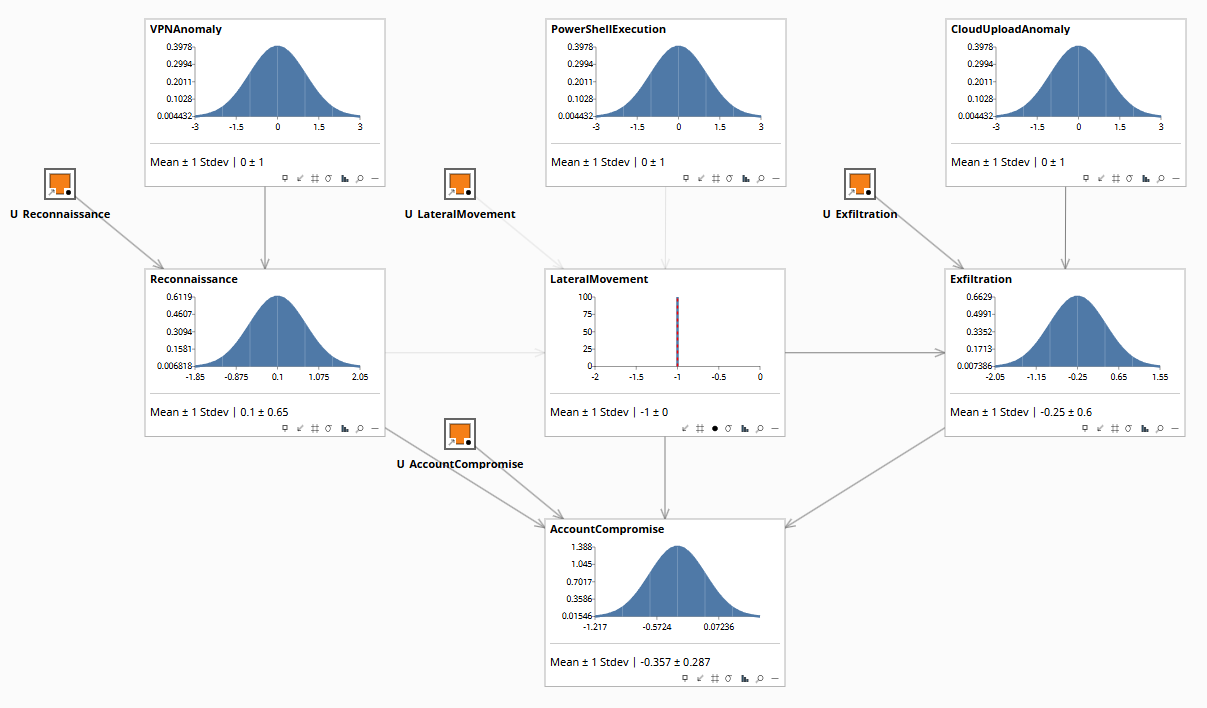
The counterfactual. When an incident is confirmed, the Rung 3 query runs: given everything that happened, would isolating the host at step 4 have prevented exfiltration? Probability of necessity: 0.78. That is the post-incident answer, not “we should have isolated earlier” but a specific probability with explicit assumptions.
Mechanism drift monitoring is especially valuable in security: when adversary tactics change, the log-likelihood of incoming observations under the current model drops. That is the signal to re-elicit the kill chain before the model diverges from the current threat landscape.
04 The Brains
The LLM reads the logs. The model assembles the kill chain.
In security, the LLM reads the logs and explains the verdict; the kill-chain model assembles the signals and computes the probability. The SOC analyst operates on the posterior, not on any individual log line.
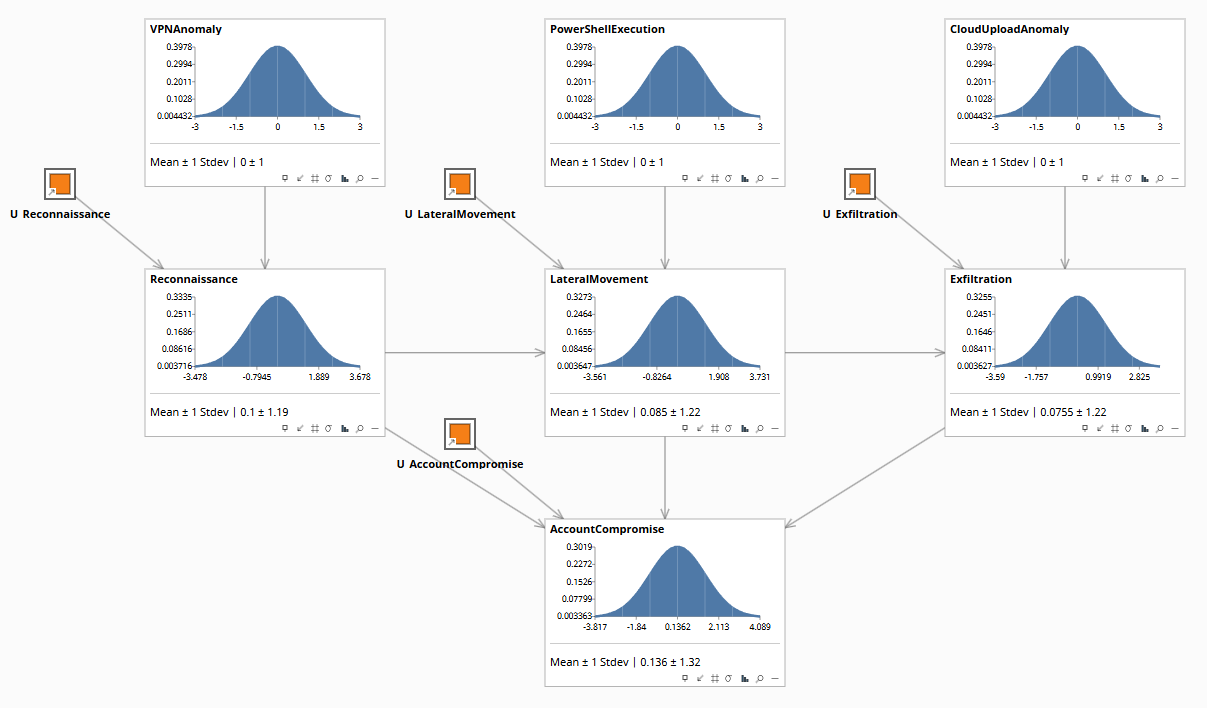
The domain model for Security Operations is a domain-specific dynamic Bayesian network encoding the kill chain. It is built via the standard EARA elicitation workflow (02 Discovery, 03 Evidence) from the organisation’s own security experts and threat intel. Optionally open it in your inference tool of choice. The model is the thing; the software that runs it is a commodity.
net = Network.load("kill-chain-v2.bayes")
bindings = [
SoftEvidence("VPNAnomaly", p=0.71),
HardEvidence("PowerShellExecution", "observed"),
SoftEvidence("CloudUploadAnomaly", p=0.58),
]
result = Inference(net).query(CausalQuery(evidence=bindings, target="AccountCompromise", rung=1))
result.posterior["AccountCompromise"] # 0.87, above escalation threshold
The model across four states
05 Query in plain English
The same primitives, pointed at the kill chain.
The same architecture, the same primitives, pointed at the kill chain.
The audit trail is the AuditRecord. The kill-chain model is the thing that made the assessment, not the individual alerts.
06 Where it sits
A cross-cutting domain application, outside the numbered sequence.
Security Operations sits outside the numbered EARA component sequence as a Cross-Cutting domain application. It uses every component in the stack: 01 Pipeline (the LLM boundary), 02–03 (domain model construction via kill-chain elicitation), 04–11 (the full suite of Cognitive Primitives), and 12 BPMN Integration (escalation and incident response workflows).
It is the clearest end-to-end worked example of the architecture in practice, a domain where the hidden-state inference problem, the temporal reasoning requirement, the explainability demand, and the counterfactual post-incident question are all present simultaneously. Every other domain application has a subset of these requirements. Security has them all.