The Pipeline
Executive TechnicalOne rule organises the whole system: the language model touches only the two ends. Everything between runs on typed artifacts and deterministic algorithms.
01 The Gap
An LLM is fluent and confident whether or not it is right.
A LARGE LANGUAGE MODEL IS FLUENT AND CONFIDENT WHETHER OR NOT IT IS RIGHT. That is acceptable for translating a question and explaining an answer. It is disqualifying for computing one. When an enterprise deploys a language model as a reasoning system, it is not making a technology choice. It is making a category error.
The language model has no explicit representation of how the world works, no mechanism for evaluating interventions, no architecture for uncertainty that holds up under audit, and no governance layer that produces artifacts a regulator can inspect. Leaving reasoning to the LLM means every answer is unreproducible, unchallengeable, and uncertified. The same question asked twice may yield different results. There is no adjustment set to point a regulator at. There is no certificate to contest.
The architecture draws a hard line. The LLM is allowed to touch only the two ends, it parses a natural-language question into a typed object, and it narrates a finished result back into prose. No natural language ever crosses into the reasoning core. No inference result is ever produced by the LLM. Reproducibility is a property of the boundary, not a hope about the model.
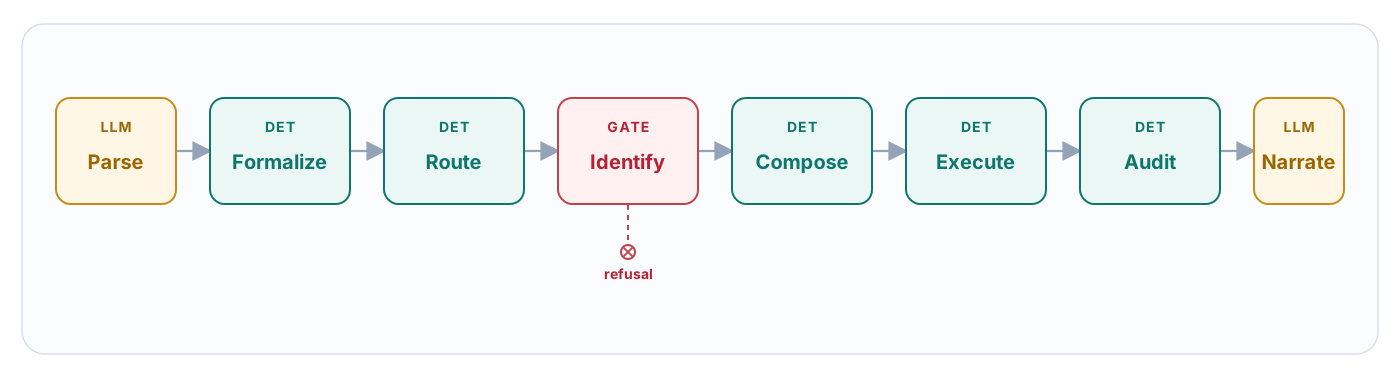
LLM stages handle language only. Deterministic stages run the same typed operation every time. The gate checks identifiability before any inference runs, if it cannot certify the query, it returns a structured refusal rather than a fabricated answer.
02 The component
The boundary architecture that separates the LLM from the reasoning engine.
The Pipeline is the Language Interface layer of EARA, the boundary architecture that separates the LLM from the reasoning core. It receives a natural-language question at the top and returns a plain-language answer with a full audit record at the bottom. Everything between the two amber ends runs on typed artifacts and deterministic algorithms.
Reference: Marc Vandenplas, Enterprise AI Reasoning Architecture: A Reference Architecture for Trustworthy Enterprise AI, Rung3.ai, 2026. Working draft.
The substrate the pipeline keys off is a Model Registry: a collection of Scope Cards, one per .bayes file. A Scope Card is a machine-readable manifest declaring what the model covers, what evidence it accepts, what targets it can infer, what interventions it can evaluate, and what gates must pass before use. Routing, identification, and composition are not heuristics over prose, they are queries against these cards. Nothing downstream works without them.
1 · PARSE LLM · constrained decode → CausalQuery
2 · FORMALIZE query → formal estimand
3 · ROUTE scope-card satisfiability → model set
4 · IDENTIFY the gate · certificate or refuse
5 · COMPOSE d-separation at the seam → composition certificate
6 · EXECUTE Bayes Server inference → posterior
7 · AUDIT bundle the record → AuditRecord
8 · NARRATE LLM · verbalize the result → plain-language answer
The two amber stages (Parse, Narrate) are the only places the LLM runs. Stage 4 (Identify) is the gate: no certificate, no answer. An unidentified query returns bounds or a refusal, never a fabricated point. The pipeline’s output is not a string. It is an AuditRecord: a typed, versioned, reproducible object.
03 How it works
Parse → Formalize → Route → Identify → Compose → Execute → Audit → Narrate.
Eight stages. Two LLM stages (amber). Six deterministic stages (white). One gate (red). Each stage is documented in full on its own page.
| Stage | Name | What it does | Detail |
|---|---|---|---|
| 1–2 | Parse & Formalize | LLM constrained decode → CausalQuery → formal estimand |
Stage 1–2 → |
| 3 | Route | Scope Card satisfiability → model set or refusal | Stage 3 → |
| 4 | Identify | The gate, certificate or refuse. No certificate, no answer. | Stage 4 → |
| 5 | Compose | d-separation at the seam → composition certificate | Stage 5 → |
| 6 | Execute | Bayes Server inference → posterior | Stage 6 → |
| 7 | Audit | Bundle the record → AuditRecord | Stage 7 → |
| 8 | Narrate | LLM verbalizes the result → plain-language answer | Stage 8 → |
04 Query in plain English
One question in. One certified answer out.
The pipeline answers one question at a time. Here is what that looks like from the outside, and what is happening on the inside at each step.
sepsis.bayes. Identification: back-door criterion satisfied on the current evidence set. P(OrganFailure = absent | do(Treatment = empirical)) = 0.83. Adjustment set: {SepticAppearance, Lactate, Age}. Certificate ID: idcert_2026_000217.sepsis.bayes via exact Bayes Server inference. The adjustment set is in the IdentificationCertificate. The counterfactual path is in the CompositionCertificate. Every number in the AuditRecord is reproducible: same model, same evidence, same estimand → same posterior, to the digit. I narrated it. I did not compute it.The audit trail is the AuditRecord, not the conversation.
05 Where it sits
Entry and exit point of the entire EARA stack.
The Pipeline is the entry and exit point of the entire EARA stack. It has no upstream component, it is where the natural-language question arrives. Every other component operates inside the boundary the Pipeline enforces.
What feeds it: a natural-language question from a clinician, analyst, or automated system, plus the Model Registry (Scope Cards for all loaded .bayes files). What it produces: an AuditRecord containing the posterior distribution, IdentificationCertificate, CompositionCertificate (if applicable), evidence set, assumptions, and model provenance, plus a narrated plain-language answer.
The models the Pipeline routes to are built through 02 Discovery and 03 Evidence. The reasoning services it invokes at Stage 6 are defined in 04 Cognitive Primitives. The AuditRecord it produces feeds 12 BPMN Integration at the governance handoff point.