Pattern Analysis
Executive TechnicalA posterior is a verdict without a reason. Two complementary analyses supply the reason: which features distinguish this hypothesis from its rivals, and which observed evidence moved the belief.
01 The Gap
“Pneumonia, 0.81.” A conclusion with its reasoning stripped off.
“Pneumonia, 0.81” is a conclusion with its reasoning stripped off. A number without a reason cannot be challenged, cannot be explained to a patient or regulator, and cannot be used to identify which part of the model to improve. The posterior tells you what the model believes. Pattern Analysis tells you why.
Two kinds of why, answering different questions. Pattern analysis asks what distinguishes this hypothesis from the ones it beat. Impact analysis asks which observed evidence moved the belief to where it is. Both are needed; neither substitutes for the other.
02 The component
Two analyses, pattern (what distinguishes) and impact (what drove it).
Pattern Analysis is a Cognitive Primitives, Epistemics component, instantiating the Explain primitive. It runs two analyses on any inference result: pattern analysis (which variables most separate the favoured hypothesis from alternatives, by Jensen–Shannon divergence (a measure of how different two probability distributions are, zero means identical, higher means more different)) and impact analysis (which evidence bindings most contributed to the current posterior, by attribution). It produces a PatternExplanation and an ImpactExplanation attached to the AuditRecord.
| Artifact | What it holds |
|---|---|
| Pattern Explanation | Given a target state and its alternatives, which variables distinguish them, ranked by how much each one separates the hypotheses |
| Impact Explanation | Given a target and the evidence entered so far, which piece of evidence moved the belief the most, ranked by attribution |
The explanation is always in the model’s own variables, never a post-hoc approximation applied to a black box. The variables that distinguish and the evidence that moved the belief are the same variables the expert elicited.
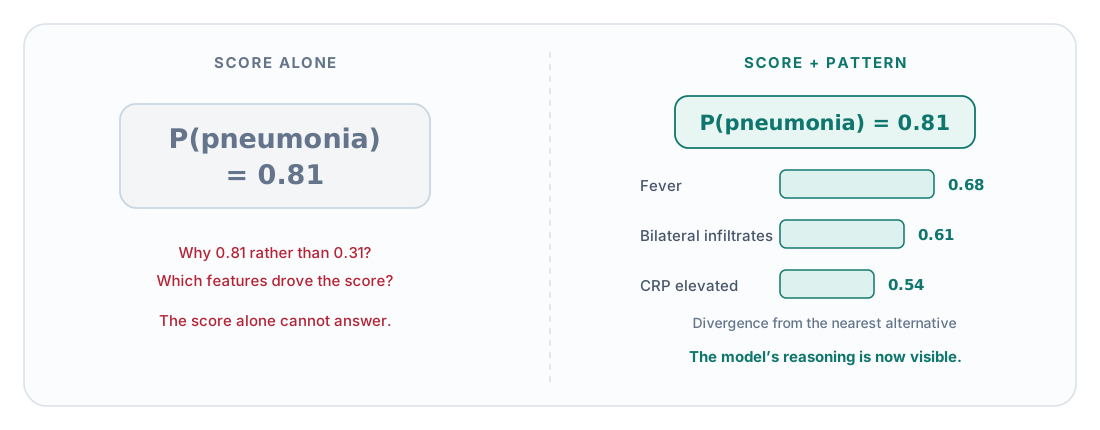
The score alone is a verdict without a reason. Pattern analysis supplies the reason: which features of this case most distinguish it from the alternatives the model considered. A clinician, an auditor, or a regulator can now see the basis, and challenge it.
03 How it works
Jensen-Shannon divergence ranks features. Attribution traces evidence.
Pattern analysis. Given a favoured state, rank the variables that most separate it from competing states by Jensen–Shannon divergence over the model. The network favours bacterial pneumonia at 0.81, CRP distinguishes it most strongly (82%), followed by lobar infiltrate (74%) and neutrophil count (69%). These are the distinguishing features, named.
Impact analysis. For each piece of observed evidence, compute how much it shifted the posterior from prior to current. Lactate shifted the sepsis posterior by +0.41; clinical appearance by +0.28; temperature by +0.02. Attribution, not distinction.
The difference. Pattern analysis tells you what to look for if you want to confirm or challenge the diagnosis. Impact analysis tells you which test or observation was most responsible for the current conclusion, the one to scrutinise first if the evidence is questioned.
04 The Brains
Reasoning made visible, not a saliency map, a causal trace.
Pattern Analysis is the brains making its reasoning visible, not through a saliency map applied post-hoc to a neural network, but through the same structural model that produced the conclusion.
There is no .bayes file for Pattern Analysis, it operates on any domain model. The PatternExplanation and ImpactExplanation are appended to the AuditRecord and constitute the explanation artifacts the pipeline is required to produce.
| Question | Top-ranked answer |
|---|---|
| What distinguishes bacterial pneumonia from viral pneumonia or PE? | CRP (0.82), Lobar Infiltrate (0.74), Neutrophils (0.69) |
| What moved the belief in Sepsis? | Lactate (+0.41), Septic Appearance (+0.28), WBC (+0.14) |
05 Query in plain English
Why?
Pattern Analysis answers the question that follows every posterior: why?
The audit trail is the PatternExplanation and ImpactExplanation in the AuditRecord.
06 Where it sits
End of the epistemic cluster, turning the posterior into an explanation.
Pattern Analysis sits at the end of the epistemic cluster (05–08), turning the posterior into an explanation the downstream components and governance layer can consume. It is required output in any regulated context where “because the model said so” is not an acceptable answer.
Upstream: the inference result from Execute (01 Pipeline stage 6) and the current EvidenceBinding set. Downstream: the explanation artifacts are appended to the AuditRecord and consumed by 12 BPMN Integration, which may require them before the decision is certified.